General Discussion
Related: Editorials & Other Articles, Issue Forums, Alliance Forums, Region ForumsA Feminine Touch
Archeology
Top 10 Discoveries of 2025
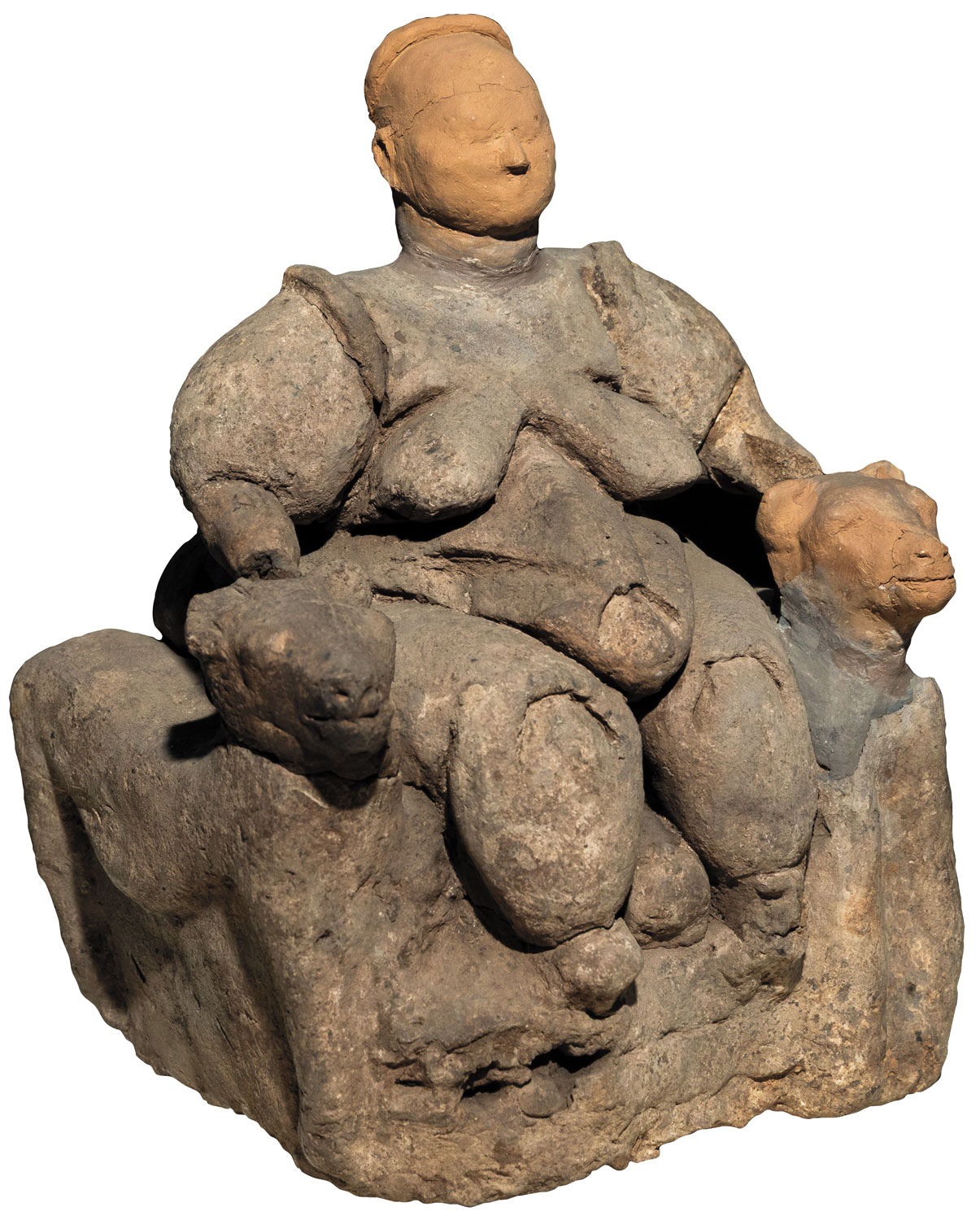
Female figurine from Çatalhöyük Photo Credit: Tolga İldun
By Daniel Weiss
January/February 2026 Edition
The large Neolithic farming community of Çatalhöyük in southern Anatolia has long tantalized archaeologists as a possible example of a matriarchal society. This interpretation was based on the discovery of figurines at the site with exaggerated female anatomy identified as “fertility goddesses.” Some scholars have advanced the theory that these sculptures were worshipped by members of “mother goddess” cults. Until recently, however, there had been no evidence that either men or women at Çatalhöyük had higher social status. A major genetic study has now convincingly demonstrated that a female-centered social structure pervaded the community.
A team of researchers analyzed DNA from 131 people buried in 35 houses on Çatalhöyük’s east mound, which was inhabited from around 7150 to 5950 b.c. The genetic material was primarily obtained from the petrous bone in the skull, which protects the inner ear, and some was extracted from teeth. The hardness and density of both the petrous bone and teeth can preserve DNA for an extremely long duration. Researchers have been able to use DNA to identify the biological sex of infant and child burials at Çatalhöyük for the first time, a determination they were unable to make from skeletal remains alone. Armed with this information, they found that female babies and children were five times as likely to be favored with grave goods as their male counterparts. “It seems to have been a very strong practice and custom,” says Mehmet Somel, an evolutionary geneticist at Middle East Technical University.
The team’s analysis also showed that people buried in a given house tended to be related along the maternal line, suggesting that women remained connected to their homes while men moved away to join their partners’ households. Eren Yüncü, also an evolutionary geneticist at Middle East Technical University, says it’s unclear what consequences organizing society around females and favoring them with grave goods had in Çatalhöyük. She suggests it may have prevented the development of social stratification. “Perhaps having more female-centered practices,” Yüncü says, “as well as the fact that perhaps females had more say in social affairs, might have helped maintain more egalitarian relationships.”
Snip.
https://archaeology.org/issues/january-february-2026/collection/a-feminine-touch/top-10-discoveries-of-2025/
🎁🎄❤️
 = new reply since forum marked as read
Highlight:
NoneDon't highlight anything
5 newestHighlight 5 most recent replies
= new reply since forum marked as read
Highlight:
NoneDon't highlight anything
5 newestHighlight 5 most recent replies

erronis
(24,468 posts)
littlemissmartypants
(34,267 posts)