General Discussion
Related: Editorials & Other Articles, Issue Forums, Alliance Forums, Region ForumsSabastian Sawe breaks world record at the London Marathon. Kenyan becomes 1st person to run a marathon in under 2 hours.

Kenyan athlete beats two-hour world record
https://www.thetimes.com/uk/london/article/marathon-2026-today-live-latest-news-x09cclzz2
https://archive.ph/DymG0

Sabastian Sawe crosses the finish line
Matthew Childs/Reuters
https://www.thetimes.com/uk/london/article/marathon-2026-today-live-latest-news-x09cclzz2#bd94f806-d1c7-4f78-9ff1-9de3f7f25e64

Sabastian Sawe won the men’s elite race
Karwai Tang
Sabastian Sawe has become the first person to run a marathon in less than two hours, setting a world record of 1hr 59min 30sec in front of cheering crowds on the Mall. The 30-year-old Kenyan has been considered the leading marathon runner in the world over the past year and won the London race last year, but that was in a time that was nearly three minutes slower than today’s record.
Breaking the two-hour barrier has been one of the most notable targets in athletics, but the closest anyone had come was in 2023 when another Kenyan, Kelvin Kiptum, set a world record of 2:00:35 that stood until Sawe’s historic run today.
Second runner beats two-hour marathon
Sabastian Sawe was not the only runner in London to beat the two-hour barrier — Yomif Kejelcha of Ethiopia finished second in a time of 1:59:41. The third-placed athlete, Jacob Kiplimo, of Uganda, recorded a time just over two hours (2:00:28) that would have been a world record before today’s race.
Sawe’s time was faster even than the one recorded by the distance running icon Eliud Kipchoge in 2019 but that was not a world record because Kipchoge was not competing in an open race and was aided by a team of rotating pacemakers and had hydration delivered by bicycle.

Sabastian Sawe, centre, Yomif Kejelcha, left and Jacob Kiplimo
John Walton/PA
snip

 = new reply since forum marked as read
Highlight:
NoneDon't highlight anything
5 newestHighlight 5 most recent replies
= new reply since forum marked as read
Highlight:
NoneDon't highlight anything
5 newestHighlight 5 most recent replies

jmowreader
(53,316 posts)It can’t just be elevation, which is what they usually say it is.

Ritabert
(2,549 posts)
Celerity
(54,782 posts)
Since the 1968 Mexico City Olympics, Kenyan and Ethiopian runners have dominated the middle- and long-distance events in athletics and have exhibited comparable dominance in international cross-country and road-racing competition.
Several factors have been proposed to explain the extraordinary success of the Kenyan and Ethiopian distance runners, including (1) genetic predisposition, (2) development of a high maximal oxygen uptake as a result of extensive walking and running at an early age, (3) relatively high hemoglobin and hematocrit, (4) development of good metabolic "economy/efficiency" based on somatotype and lower limb characteristics, (5) favorable skeletal-muscle-fiber composition and oxidative enzyme profile, (6) traditional Kenyan/Ethiopian diet, (7) living and training at altitude, and (8) motivation to achieve economic success.
Some of these factors have been examined objectively in the laboratory and field, whereas others have been evaluated from an observational perspective. The purpose of this article is to present the current data relative to factors that potentially contribute to the unprecedented success of Kenyan and Ethiopian distance runners, including recent studies that examined potential links between Kenyan and Ethiopian genotype characteristics and elite running performance.
In general, it appears that Kenyan and Ethiopian distance-running success is not based on a unique genetic or physiological characteristic. Rather, it appears to be the result of favorable somatotypical characteristics lending to exceptional biomechanical and metabolic economy/efficiency; chronic exposure to altitude in combination with moderate-volume, high-intensity training (live high + train high), and a strong psychological motivation to succeed athletically for the purpose of economic and social advancement.
snip

ananda
(35,384 posts)They're winners over so many people
who don't believe in science or evolution.

GenThePerservering
(3,579 posts)He said that he felt that he and all of London participated in this record, as he felt their support. I've never run the London Marathon, but I know all of the points on that course well.
The east Africans run from childhood - it's embedded in their culture - run distances to school (Eliud Kipchoge holds one of his arms in a somewhat peculiar position as that's how he held his schoolbooks when he was a boy), and they have the perfect build and physiology to do it. Curiously, according to quite a number of them, most of their countrymen don't continue running as adults, although obviously others do.
The elite runners go out so fast that the pacing bikes have to sprint to stay ahead - I saw this when I was at the Honolulu Marathon when the front pack (pacing bikes/wheelchairs/elite runners) - we hadn't started yet (big crowd) and the front pack had taken the turn onto the main course. I saw the lean cyclists on their racing bikes hauling like crazy up the slight hill to stay ahead of the pack, all in the misty pre-dawn darkness.

Danascot
(5,260 posts)Sabastian Sawe, the winner and Yomif Kejelcha, the second place finisher (both of whom broke the world record) were both wearing Adidas supershoes that are 30% lighter and have better energy return than regular running shoes. Women's winner, Tigst Assefa who also broke the world record was wearing the Adidas shoes.
https://therunningchannel.com/the-new-500-shoe-on-the-feet-of-london-marathon-winners/

eppur_se_muova
(42,263 posts)Centuries of carrying messages over the hilly trails must have led to some form of selection for good runners, even if only social and economic. If successful runners had more children, and/or married relatives of other good runners, or more of their children survived, you'd end up with a statistically significant accumulation of genes which favor the physiology of good runners.
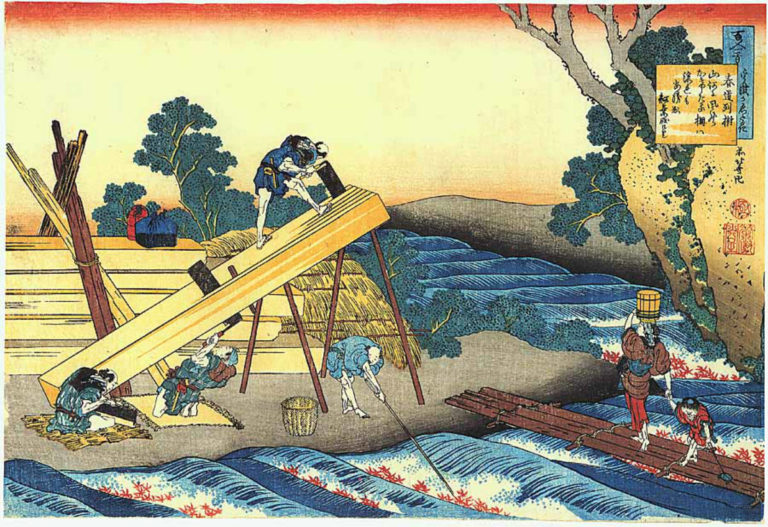
Similar things have happened in ancient societies where one's choice of profession is often dictated by birth -- pursuing your father's profession even may be forced in some cases. Political and social classes, not to mention ethnic associations, may also limit your options. Apparently, if you meet someone unusually tall and strong in Japan, he may be descended from a long line of sawyers -- men who cut trees into boards before sawmills were mechanized -- who were allowed much larger rations of rice than other workers (carbo-loading ! ), by law.