Environment & Energy
Related: About this forumClimate scientist calls for 'world war type mobilization' to combat climate change
Last edited Thu Jul 4, 2019, 05:28 PM - Edit history (1)
https://thehill.com/hilltv/rising/451497-climate-scientist-michael-mann-calls-for-world-war-type-mobilization-to-combat7/3/2019
(Video available at link - OKIsItJustMe)
Climate scientist Michael Mann is calling for a “world war-type” mobilization to address climate change.
“We do need a world-war type mobilization and that means putting in place incentives to move our economy as quickly as we can away from fossil fuels to renewable energy,” Mann, a scientist at Pennsylvania State University who is known for taking on climate skeptics, told Hill.TV in an interview that aired Wednesday.
“Now how we do that, there’s a legitimate policy debate to be had about how we do that but there isn’t a legitimate debate to be had anymore about the need to do that,” he added.
Mann warned that lawmakers should take immediate action, arguing that the Trump administration is actively seeking to dismantle 50 years of environmental protections put in place by both Democratic and Republican administrations.
…
James Hansen (et al) made a similar call in 2008:
https://pubs.giss.nasa.gov/docs/2008/2008_Hansen_ha00410c.pdf
The most difficult task, phase-out over the next 20-25 years of coal use that does not capture CO₂, is Herculean, yet feasible when compared with the efforts that went into World War II. The stakes, for all life on the planet, surpass those of any previous crisis. The greatest danger is continued ignorance and denial, which could make tragic consequences unavoidable.
…
 = new reply since forum marked as read
Highlight:
NoneDon't highlight anything
5 newestHighlight 5 most recent replies
= new reply since forum marked as read
Highlight:
NoneDon't highlight anything
5 newestHighlight 5 most recent replies

BlancheSplanchnik
(20,219 posts)Just the same ole, Eat, Sleep, Breed. Repeat until we get closer and closer to eight billion.

OKIsItJustMe
(21,877 posts)The US has a relatively low total fertility rate (births per woman) compared to Africa:
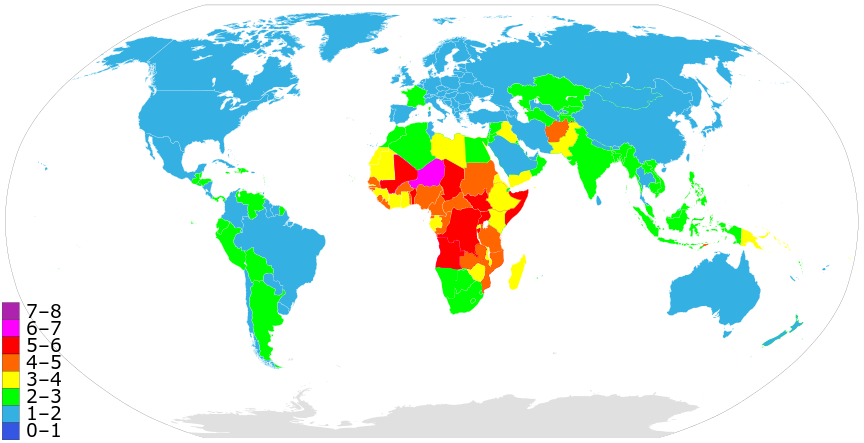
Map of countries by fertility rate (2018), according to CIA World Factbook
Yet, the US is the primary source of carbon dioxide emissions:
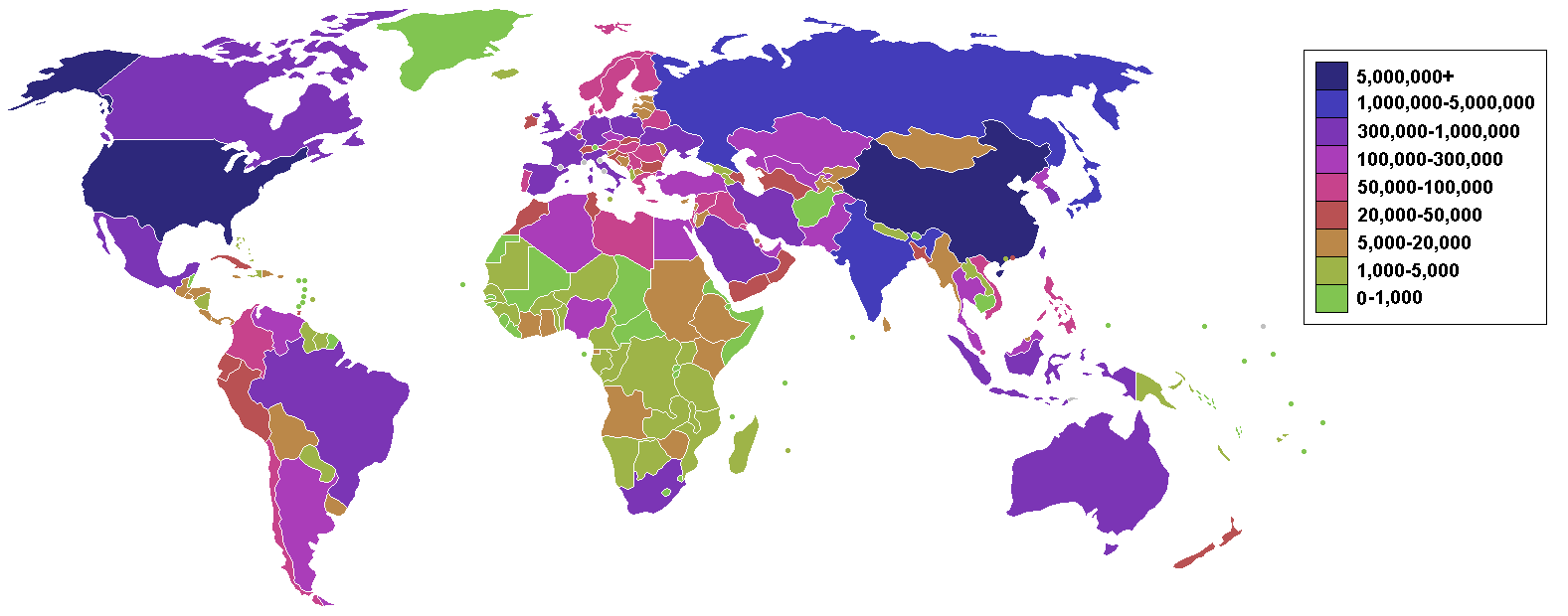
Countries by carbon dioxide emissions in thousands of tonnes per annum, via the burning of fossil fuels (blue the highest and green the lowest).
The reason is our very high per capita CO₂ emissions:

Birth rates clearly are not the cause of "climate change."
By harping about "birth control," US citizens can blame Africans for "climate change" because their birth rate is so high. If our per capita CO₂ emissions matched Africa’s, we wouldn’t be in this predicament.
That’s why I have decided the meme is racist in nature.
It’s also a convenient excuse not to do something difficult, like cutting our per capita emissions. After all, such efforts are useless if those Africans are going to keep breeding? (Right?)
BlancheSplanchnik
(20,219 posts)And most of all, never had kids. Human overpopulation is a global problem, as we are all intertwined. And yes, our carbon emissions are extremely high.
An emeritus professor of tropical ecology I knew said the worst ecological problem is human overpopulation as it drives everything else. The problem is, no one wants to hear about it.
OKIsItJustMe
(21,877 posts)But either of us produce more CO₂ than the average African family.
https://www3.epa.gov/carbon-footprint-calculator/
https://www.wwf.org.za/?6242/aefreportdoc
BlancheSplanchnik
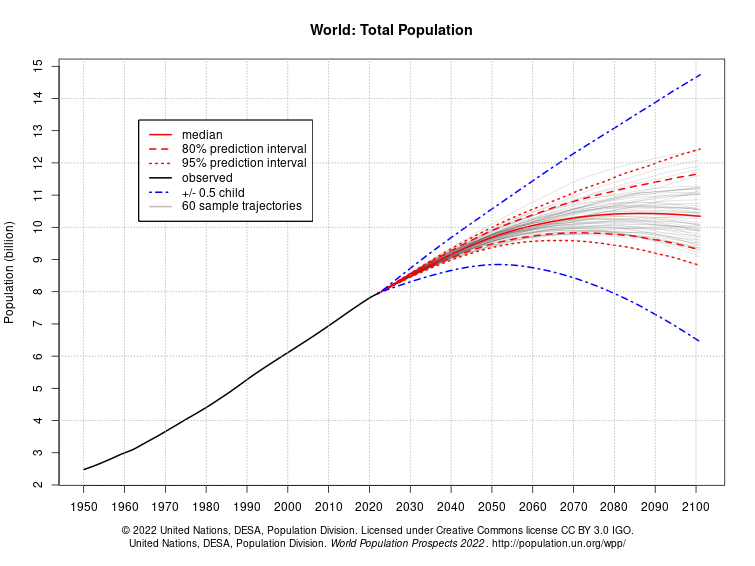
(20,219 posts)Another point to consider, American birth rates may be down, but net population isn’t.
OKIsItJustMe
(21,877 posts)https://population.un.org/wpp/Graphs/Probabilistic/POP/TOT/900
Total fertility is dropping:
https://population.un.org/wpp/Graphs/Probabilistic/FERT/TOT/900
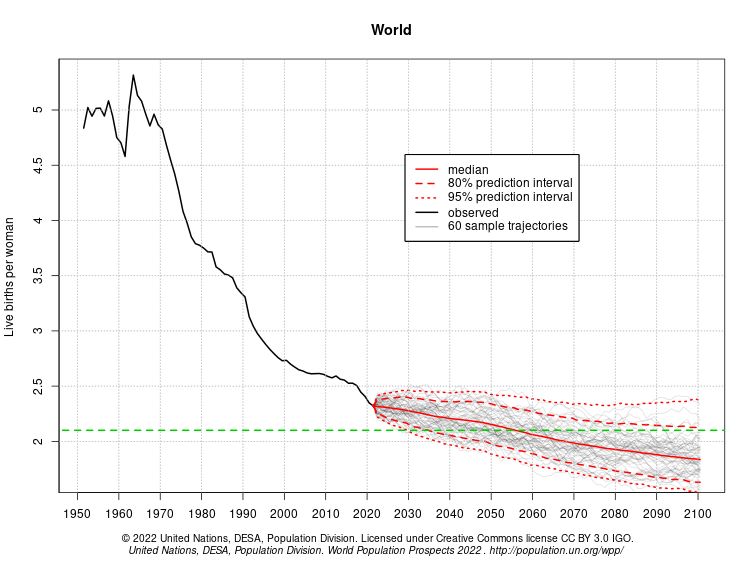
We need to make dramatic changes in about 10 years. Decreasing total fertility won’t have much of an effect on population in 10 years. On the other hand, if the existing population of the “developed world” cut their personal emissions to something close to that of the “third world…”

The_jackalope
(1,660 posts)So the absolute growth is offsetting the falling TFR. Each 80 million people (about a new Germany every year) need to be fed, no matter where they live. They need to be housed, transported, educated, provided with basic medical and sanitation services...
The fact that the growth rate is falling is irrelevant until the absolute population growth begins to fall.
For someone in the developed world, the cumulative CO2e saving of having one less child is 58.6 tonnes per year - far ahead of living car free, which is in second place at 2.4 tonnes per year.
That's a good thing, because it means that here in the industrialized West, birth control might help fight climate change. As long as the world population keeps rising, however, the total draw on other resources like cropland, fresh water, fish etc. will continue to rise - as will the conversion of natural habitat for human use to support that growth.
Is birth control the global answer? IMO, probably not - our addiction to families is too strong. It will likely take an intervention by Mother Nature in the form of a pandemic or two (or three or four) to drop our absolute population numbers significantly.
BlancheSplanchnik
(20,219 posts)Yep, we need a new plague, as Dwight Schrute once said.
NickB79
(20,386 posts)Deforestation, water shortages, habitat loss due to farming expansion and poaching, overfishing, pollution from factories, etc.
All are directly related to a surging population. If climate change wasn't a thing, there are still good reasons to be promoting more birth control for our species.
OKIsItJustMe
(21,877 posts)The population? Or the volume of waste per capita?
Why is it that the US needs to export tons and tons of waste? After we import consumer goods from Chinese factories, use it for a few years, throw it away, and replace it. Is Africa's population buried in waste?
Last year, I was at an event where I wore a name tag. However, unlike the usual "safety pin," this tag was held onto my shirt using a set of powerful magnets, while my name tag was attached to a steel plate. It was explained that this was so much nicer than poking holes in my shirt, or getting adhesive on it.
I explained that those miraculous magnets were made using rare earth metals produced in China under horrible environmental conditions, and that participants likely would throw them out without a second thought.
I have in my possession metal and wooden items which are generations old. No deforestation is needed to use them, no pollution from a factory.

progree
(13,031 posts)and yes, today the low fertility countries lead, by far, in both waste per capita and total waste ... but if the high fertility countries reach even the per-capita consumption and waste levels of say China ....
OKIsItJustMe
(21,877 posts)Therefore fertility is not the problem per se.
One of the reasons for a low fertility rate is a reasonable assurance that your children will live a long life. In “developed countries” that assurance is greater, so mothers feel less of a need to have a large number of children.
On the other hand, their children consume more resources per capita…
https://www.un.org/en/development/desa/population/publications/pdf/popfacts/PopFacts_2017-3.pdf
In recent decades, developing countries around the world have been undergoing a demographic transition, characterized by increasing levels of life expectancy at birth and declining levels of lifetime fertility. Many of these countries are now reaching levels of mortality and fertility that are similar to those seen in the more developed countries.
…
1. The percentage of the world’s population living in high-fertility countries has been declining rapidly
In 1975-1980, close to a quarter of the world’s population lived in countries with high levels of fertility as defined here. Twenty years later, in 1995-2000, the share of the global population that lived in high-fertility countries had fallen to 11 per cent. In 2010-2015, 8 per cent of the global population lived in countries where women were having, on average, more than 5 births over a lifetime. Starting in 2025-2030, it is expected that less than 1 per cent of the world’s population will live in countries with such high levels of fertility.
…
progree
(13,031 posts)So like I say, those declining fertility projections are wonderful and all that, but we're a long way from population growth not being a big problem, especially if the countries with the high fertility (say 3 or more on average / women) reach the per capita resource consumption and pollution emissions of all kind as, say, China.
For example, the U.N. (in its 2019 report) projects Africa's current 1.3 billion population to reach 2.5 billion in 2051 (and nearly 4.3 billion in 2100). (using that Interactive Data tool https://population.un.org/wpp/ ).
If their per-capita impact remains the same as now, it wouldn't be that big a deal on a global basis (locally, that's a way different matter). But if their per-capita impact reaches the level of China's today, it's a whole 'nuther story.
It's a big ticking time bomb. But I also have hope (#14 below)
https://www.democraticunderground.com/?com=view_post&forum=1127&pid=129133
(Unfortunately I'd add that I think environmental factors and resource limitations will be the biggest reason for population falling short of projections).
I lived a number of years in Lagos, Nigeria around 1967-1971. Am so saddened to see Lake Chad almost entirely dried up, and living standards falling (I can dig up a recent article about that).
OKIsItJustMe
(21,877 posts)Thanks to a phenomenon known as population momentum, a youthful population with constant levels of mortality and a net migration¹ of zero continues to grow even when fertility remains constant at the replacement level.² In this situation, a relatively youthful age structure promotes a more rapid growth, because the births being produced by the relatively large number of women of reproductive age outnumber the deaths occurring in the total population, even if the fertility of the average woman stands at the replacement level.
…
Under the assumptions of the momentum variant, the world’s population would continue to increase in the coming years and decades, reaching 8.3 billion in 2030 and 8.9 billion in 2050. Thereafter, the global population would stabilize at around 9 billion. Compared to an estimate of around 7.4 billion for 2015, an additional 1.5 billion persons would thus be added to the world’s population by 2050, even if fertility were to reach the replacement level instantly and if mortality were to remain constant at levels observed in 2010-2015.
…
Now, just for purposes of argument, let's say that everyone stopped having babies altogether tomorrow. Now, clearly, after 100 years or so, the “population problem” would be “solved.” (Right?)
The thing is, we need to address the “climate crisis” in a shorter time frame than that. So, “population control” is clearly not a viable solution.
So, how do we address the “climate crisis?”
- By cutting emissions.
- By actively removing Greenhouse Gases from the atmosphere.
progree
(13,031 posts)as I and others enumerated too many times already in this thread.
And reduce human misery, particularly in the highest growth countries.
OKIsItJustMe
(21,877 posts)The topic of this thread is, “Climate scientist calls for 'world war type mobilization' to combat climate change”
progree
(13,031 posts)Last edited Sun Jul 7, 2019, 09:52 PM - Edit history (1)
Edited to add:
Just like building thousands of wind turbines or planting millions of tree will help, but it's not enough to be the whole solution.
I have no illusion that reducing population growth alone, or even drastically reducing world population by even, say 80%, will be the WHOLE solution to the climate change problem, as long as per-capita GHG emissions are anywhere near where they are now.
progree
(13,031 posts)I think that reasoning is fading fast in Africa. What's often lacking though is modern contraception. Hell, "modern contraception" includes the birth control pill, which in actual "usage" in the U.S. has about a 1 chance in 11 per year of failure (9%/year). It's failure rate is much much lower (0.3%/year) when it is meticulously taken as instructed.
From the December 2017 issue of Population Connection magazine, which has all the contraceptives and methods
http://www.populationconnection.org/magazine/december-2017/
In many African nations I suspect the failure rate would be on average higher than 9% as so many live near the limits of survivor in chaotic conditions.
Even in the U.S. .... where nearly half of pregnancies are unintended ... (due to shitty cheap birth control methods like the pill. Results are much better with LARC (long acting reversible contraceptives), such as the implant (0.05% failure rate, but expensive).
From the December 2017 issue of Population Connection magazine, which is focused on male contraception.
http://www.populationconnection.org/magazine/december-2017/
Another is that the attitude of too many men is well ... anyway, many African women feel the need to hide their contraception-taking. That's hard to do with the pill ... and being secretive makes it that much harder to stick to taking every day at about the same time each day.
Whereas the implant, besides being much more reliable, is also hidden.
The "social security" of large families doesn't seem to be a big concern in Addis Ababa (near replacement level fertility) or in Botswana (fewer than 3 children/woman average).
Just getting these impressions from reading Population Connection magazine and various articles from wherever I run into them...
NickB79
(20,386 posts)In the end, the absolute numbers are all that matter. The fact that the average Chinese citizen's per capita CO2 emissions are less than that of a US citizen means nothing when the sheer number of Chinese citizens produces as much CO2 as the number of Americans. In the end, the planet still keeps warming, forests still get cut, and oceans still acidify.
I've come to the belief that "per-capita" measurements are being used as weasel words to falsely give the impression a nation is actually making strides to protect the environment when they really aren't.
Beyond that, all those high-birthrate nations are moving at breakneck speed to achieve Western lifestyles, complete with our levels of resource consumption. The low-birthrate nations aren't trying to reduce their impact in any meaningful way. All the trends are going in the wrong direction, sadly.
OKIsItJustMe
(21,877 posts)OK! This is great! We can dissolve the federal government, call each of the 50 states nations, and nature will be happy again!
Of course per capita emissions matter!
Consider a society where individuals live alone in multi-room homes, with furnaces and air conditioners and cars and 8K smart TV's. Now, consider a society where multiple generations share a single communal dwelling, with none of those things.
Which one will have more impact on the climate?
BlancheSplanchnik
(20,219 posts)Crime rates, societal violence, uglification (my word for suburban sprawl), casual nastiness and more... all relate back to our overcrowding.
progree
(13,031 posts)The actual figures from the UN 2019 report (median projection):
2019: 7,713,468
2100: 10,874,902
A 41% increase
https://population.un.org/wpp/
But as OKIsItJustMe points out, our problem is not just human numbers, but the amount of resource depletion and pollution and emissions they create on a per-person basis (and generally speaking, the lowest fertility countries being the worst per capita and overall) -- depleting ground water and polluting it with salt and nitrates and other chemicals (surface water too), deforestation, soil loss, pollution including all the plastics, fish depletion, species extinction, loss of biodiversity.... simply eliminating GHG emissions doesn't fix these other problems.
And the human misery that goes with it -- as far as humans getting their act together -- there is an unmet need for effective contraceptives for more than 200 million women in the world, and so little is done to help them).
https://www.populationconnection.org/magazine-archives/
BlancheSplanchnik
(20,219 posts)Population Connection, yep...I’ve donated to them. I hope it helps a little bit. 😞
OKIsItJustMe
(21,877 posts)No, seriously, if people only lived to 50 or 60, rather than 80 or 90, the population would be a good deal lower. There'd be a lot less "medical waste" the benefits would be tremendous.
Cut pre-natal care as well, the definition of Total Fertility is the average number of live births per woman. Stop immunizing children.
The original Star Trek series had an episode where a society is looking for Kirk to give them a contagious disease, so people will die and make room on their overpopulated planet.
That episode dates back 50 years, to a time when the population of Earth was growing but quite significantly lower than today.
progree
(13,031 posts)and they don't propose any of those solutions or make any of these kinds of arguments. Just making contraception and reproductive health services available to all who want them.
Cut pre-natal care as well, the definition of Total Fertility is the average number of live births per woman. Stop immunizing children.
Oh, FFS


I know you are being satirical / sarcastic (I think) but what is the purpose? What is the point?
OKIsItJustMe
(21,877 posts)However, in all seriousness, global population exploded with modern health care.
BlancheSplanchnik
(20,219 posts)☹️
Must be repukes are actually trying to help by killing people off. 😒
OKIsItJustMe
(21,877 posts)We would need some sort of "weapons of mass destruction" of course… A build-up of our nuclear arsenals might be helpful.
Traditionally population control has been provided by the "four horsemen."

BlancheSplanchnik
(20,219 posts)Sad that people can’t or won’t regulate their breeding. I know of dudes with 8 or more kids floating around because they like variety but dislike condoms.
OKIsItJustMe
(21,877 posts)On the other hand, if you're going to solve the climate crisis, you need to address the real culprits.
If Africa had half as many live births per woman, but those babies lived a typical US lifestyle, things would be so much worse.
progree
(13,031 posts)Last edited Fri Jul 5, 2019, 02:11 PM - Edit history (1)
since Africa now has about the same population as China. Which could happen (same per-capita emissions and GDP as China), since it would be a racist meme (and incorrect) to say they are fundamentally incapable of doing that.
(China now emits more CO2 than the U.S. and the E.U. combined)
https://www.forbes.com/sites/rrapier/2018/07/01/china-emits-more-carbon-dioxide-than-the-u-s-and-eu-combined/#6f580d7f628c
and if Africa's population doubles by 2051 as the UN report predicts, then we will have like 3 Chinas.
and if it reaches 4.3 billion by 2100, again as the U.N. predicts (medium projection), then we will have like 5 Chinas.
https://population.un.org/wpp/
using the Interactive tool
Edited to add - I don't think Africa's population will get anywhere near to either of these levels. When modern contraception is widely available, the fertility rate goes way down. Addis Ababa's fertility rate is at about replacement level, for example (capital of Ethiopia) - Population Connection Magazine, 3/2016 .
And the country of Botswana has reduced it fertility rate to under 3 per woman, and falling.
Population Connection Magazine, 3/2019 .
https://www.populationconnection.org/magazine-archives/