Environment & Energy
Related: About this forumEnergy Production and Use Graphics: Sankey Diagrams of the World, Germany, and France.
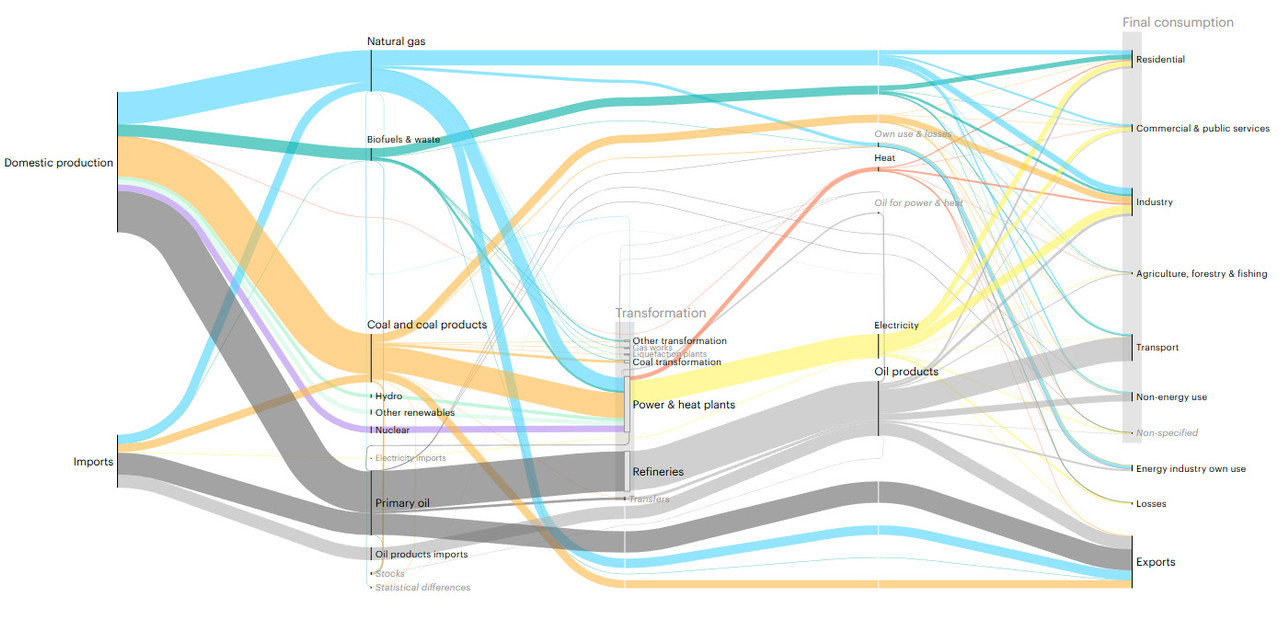
A useful type of flowchart is called a "Sankey diagram," which in energy shows the primary sources of energy and how it is used in industry, transportation and residential settings.
The IEA had an extensive body of these going up to 2023 along with a description (on the linked page) of how to view them, along with a slider that can show the evolution of the diagrams from 1990 to 2023.
The graphics are partially interactive on line, but won't be in this post. The energy units are the SI unit Terrajoule, which is a millionth of an Exajoule.
Here, for convenience, is the Sankey Diagram of the whole world for 2023 which shows up when you click on the link:

Here is the Sankey Diagram for the whole world in 1990:

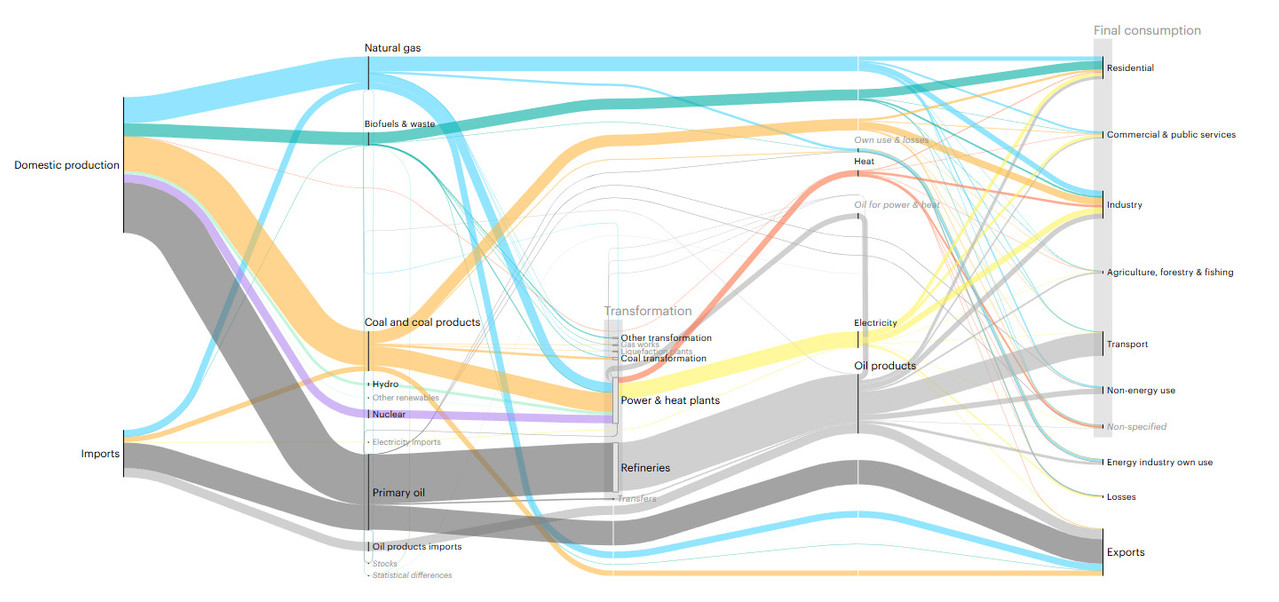
You may have heard in lots of lots of places at DU and in the world beyond about an "Energy Transition" that's supposed to be underway.
Really? Am I missing something? I can't see any "Energy Transition" prominent in comparing the 1990 and 2023 Diagrams.
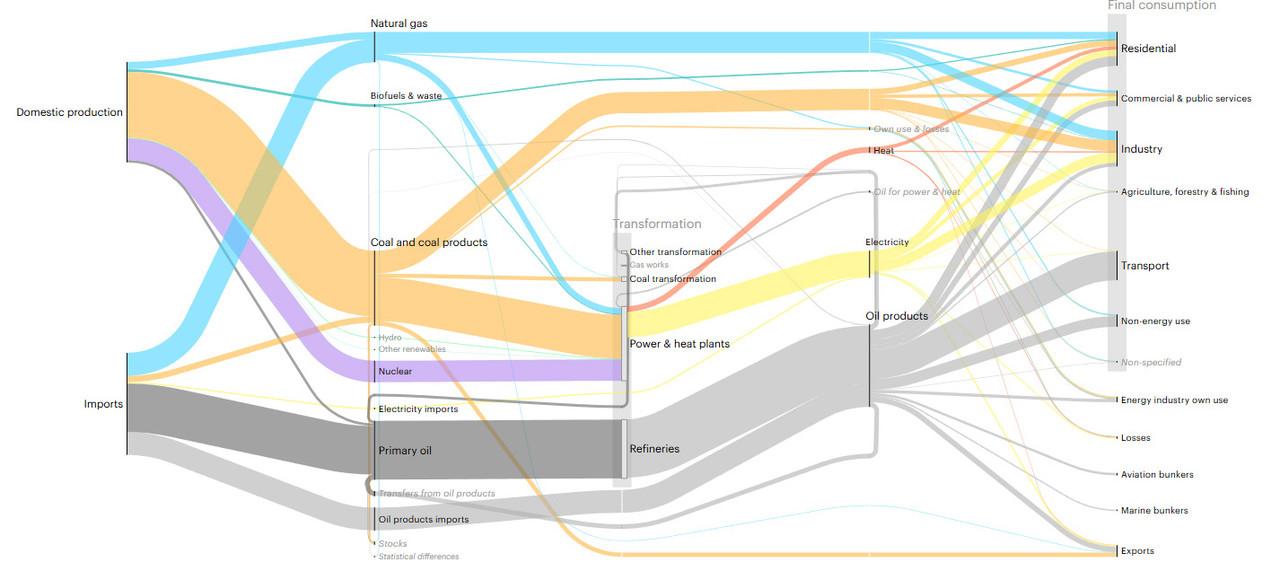
Now two European Countries in 1990 and 2023. First Germany, in 1990 before the dubious antinuke "victory" over nuclear energy:

Germany in 2023, the year it shut its last nuclear plants, thereby deciding to kill people by burning coal and gas:

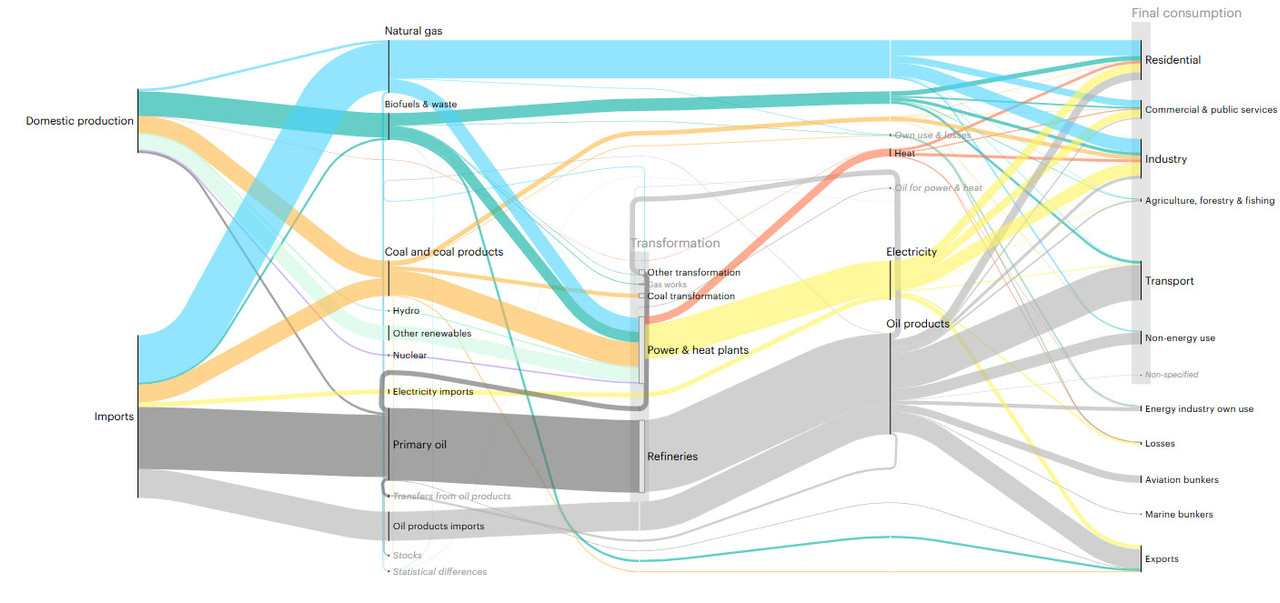
Germany, as the United States did in the last 30 years, reduced, but did not eliminate dependence on coal, but to the extent coal was replaced, it was largely by dangerous natural gas. So called "renewable energy" is trivial in Germany as it is in the rest of the world, despite its 5.6+ trillion dollar price tag.
Let's turn to France:
France in 1990:

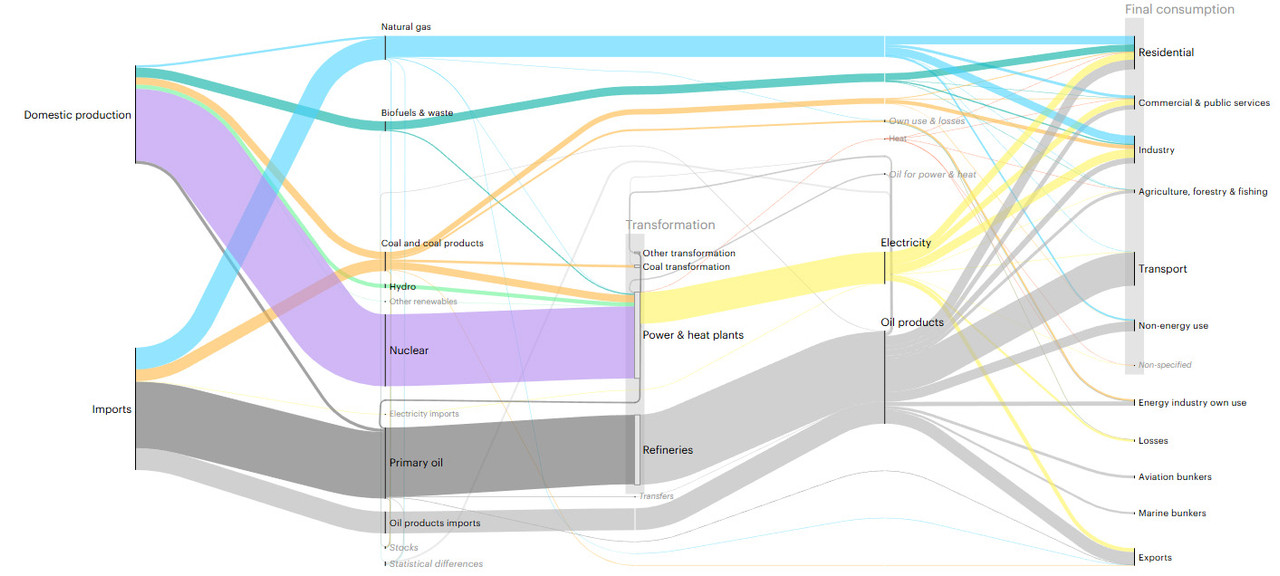
France in 2023:

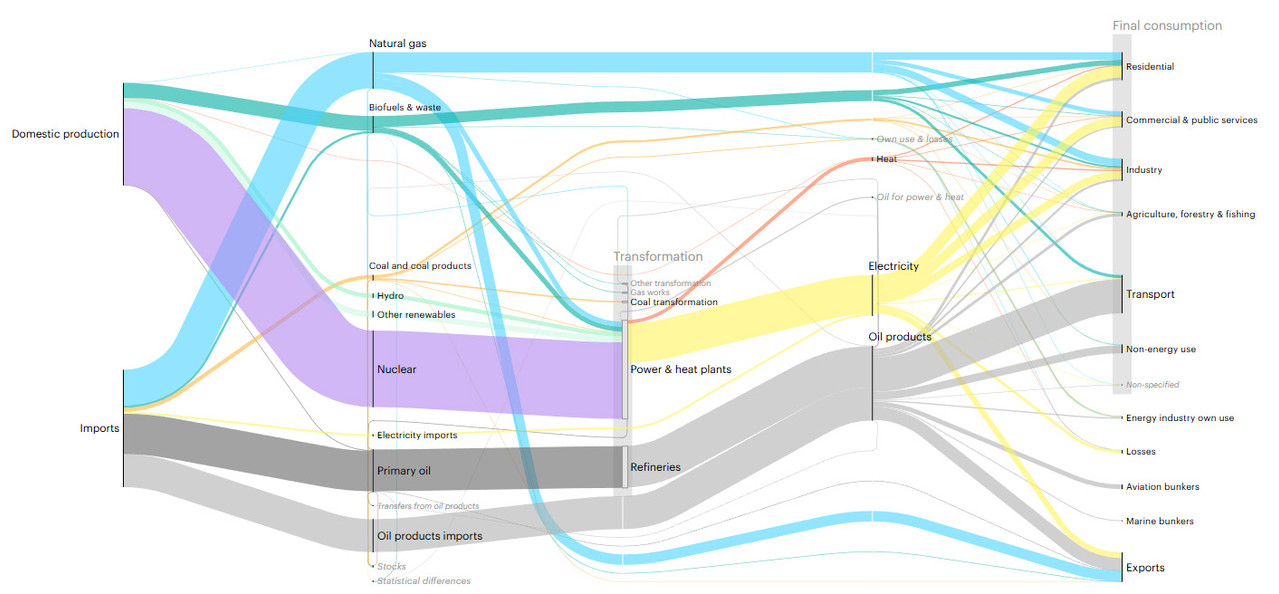
In 1990, France's real energy transition from coal to nuclear was already underway. As of 2023, the tiny amounts of coal imported into France are not used for power generation, but for materials use.
From 1990 to 2025, as far as electric power was concerned, France didn't need an "energy transition." They were (and are) way ahead of the rest of the world, still the only nation on Earth without much hydroelectric capacity to rely almost exclusively on clean nuclear power. One may ask to compare the number of people in France who were killed by exposure to radiation from power plants to the number of people killed by coal waste dumped into the planetary atmosphere by the antinuke Germans.
To me, these Sankey diagrams graphically demonstrate something called "reality," despite all the popular sloganeering about "energy transitions."
Have a nice evening.
 = new reply since forum marked as read
Highlight:
NoneDon't highlight anything
5 newestHighlight 5 most recent replies
= new reply since forum marked as read
Highlight:
NoneDon't highlight anything
5 newestHighlight 5 most recent replies

DemocracyForever
(313 posts)No one has figured out how to dispose of the highly toxic nuclear waste. Nuclear power is more expensive than wind and solar. I fear that the well funded nuclear power industry is becoming the fossil fuel industry of the 21st century.

NNadir
(38,853 posts)...fossil fuel waste, aka "air pollution." I am not talking about the destruction of the planetary atmosphere, about which antinukes couldn't care less. (They are perfectly satisfied with the Sankey diagrams reproduced in the OP.)
Reference: : Global burden of 87 risk factors in 204 countries and territories, 1990–2019: a systematic analysis for the Global Burden of Disease Study 2019 (Lancet Volume 396, Issue 10258, 17–23 October 2020, Pages 1223-1249).
Here's what I post as an excerpt of that paper - many other similar papers are available to show how many people are killed by antinuke's selective attention - that I produce when I hear the caterwauling about so called "nuclear waste,"
Here is what it says about air pollution deaths in the 2019 Global Burden of Disease Survey, if one is too busy to open it oneself because one is too busy carrying on about Fukushima:
That works out to about 19,000 people every day, about 800 people per hour.
Atter I always challenge people who know nothing at all about used nuclear fuel to show in the 70 year history of commercial nuclear energy to show that the storage of used nuclear fuel has killed as many people as will die as will die in the next 8 hours from fossil fuels, that would be a little over 6000 people.
Only reports from the primary scientific literature can be used to support the claim that the storage of used nuclear fuel on this planet has killed, over its 70 year history, 6400 people in answer to this challenge.
I am an expert on the composition, the chemistry, and the physics of all the components of used nuclear fuel, which I regard as a critical resource for saving the world.
Let me say that again: I consider used nuclear fuel to be a critical resource for saving what is left to save and possible even restoring that which can be restored. It can be shown that the uranium and thorium already mined could support all of the planet's energy needs for centuries, meaning no oil, no coal, no gas, and no vast areas of wilderness destroyed for so called "renewable energy" and no climate degradation such as is now observed.
Nuclear energy need not be risk free to be vastly superior to all other forms of energy. It only needs to be superior to everything else, which it is.
In 2013, the climate scientist James Hansen and a colleague published a highly cited paper showing how many lives had been saved by nuclear power. I post a link to it often: Prevented Mortality and Greenhouse Gas Emissions from Historical and Projected Nuclear Power (Pushker A. Kharecha* and James E. Hansen Environ. Sci. Technol., 2013, 47 (9), pp 4889–4895)
If it is true, and I do not doubt it is, it follows that opposing nuclear energy kills people. Opposing nuclear energy kills more than people. It's killing the planet.
The selective attention of antinukes, their complete lack of knowledge of the subject, is neither ethically nor practically an excuse to kill the planet.
Have a nice day.