Environment & Energy
Related: About this forum2026 Study on whether EV's are better for the environment than ICE vehicles (not one from 2019)
whoops - wrong link
Link to tweet
?s=20
 = new reply since forum marked as read
Highlight:
NoneDon't highlight anything
5 newestHighlight 5 most recent replies
= new reply since forum marked as read
Highlight:
NoneDon't highlight anything
5 newestHighlight 5 most recent replies

NNadir
(38,869 posts)...aren't they?
Meanwhile, on planet Earth:
Weekly average CO2 at Mauna Loa
Week beginning on June 14, 2026: 431.17 ppm
Weekly value from 1 year ago: 429.43 ppm
Weekly value from 10 years ago: 407.35 ppm
Last updated: June 25, 2026
All those mines, and all those slaves in Africa digging in them to make batteries seem not to have put out the fires.
WHO CARES?????? WE HAVE OUR CARS!!!!
The indecency of our bourgeois class never seems to reach a bottom, does it.
A burning planet, but well, hydrogen and batteries. The myopia and the contempt for the planet and the people on it is astounding, absolutely astounding.
Things are so hot that to me at least, as an environmentalist who deprecates consumer indifference, even my own, that antinuke heaven, a celebration of depravity, seems to me to be as hot and as horrible as hell.
As for a tweet claiming to overrule a scientific paper in 2019, this one in 2024 is a little more credible, at least to someone with respect who has any respect for science (not to mention decency):
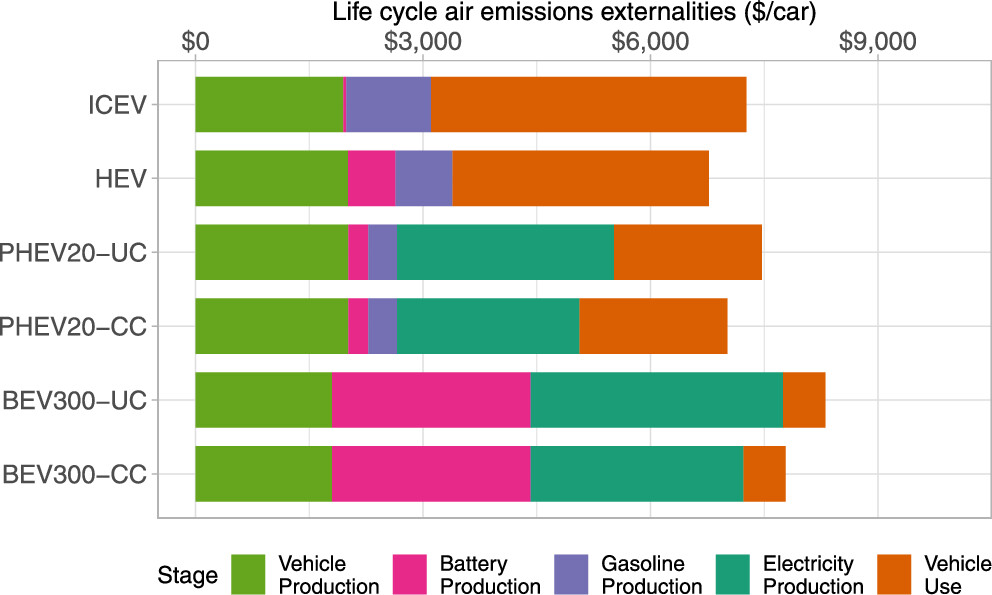
It looks like on my grid, my type of car is the least obnoxious, although all cars are obnoxious, including mine.
On and it's not like people really wait until the sun is shining and the wind is blowing to charge their "green" electric cars, is it?
Tweets pretending to offer magic "MIT" as the ultimate authority actually don't mean anything when we look at the data at the Mauna Loa observatory. I have no idea what the reference to "2019" in the OP might mean, but in week beginning June 23, 2019, the concentration of the fossil fuel waste carbon dioxide in the planetary atmosphere was 413.35 ppm, about 18 ppm lower than it is just 7 years later.
The problem is vast ignorance of what electricity is and where it comes from. Our bourgeoisie around here seem to think it comes out a wall socket connected to some industrialized former wilderness bulldozed into an industrial park for so called "renewable energy." The reality is that it's overwhelmingly generated, everywhere on the planet by the combustion of dangerous fossil fuels.
The IEA had an extensive body of these going up to 2023
Here, for convenience, is the Sankey Diagram of the whole world for 2023 which shows up when you click on the link:

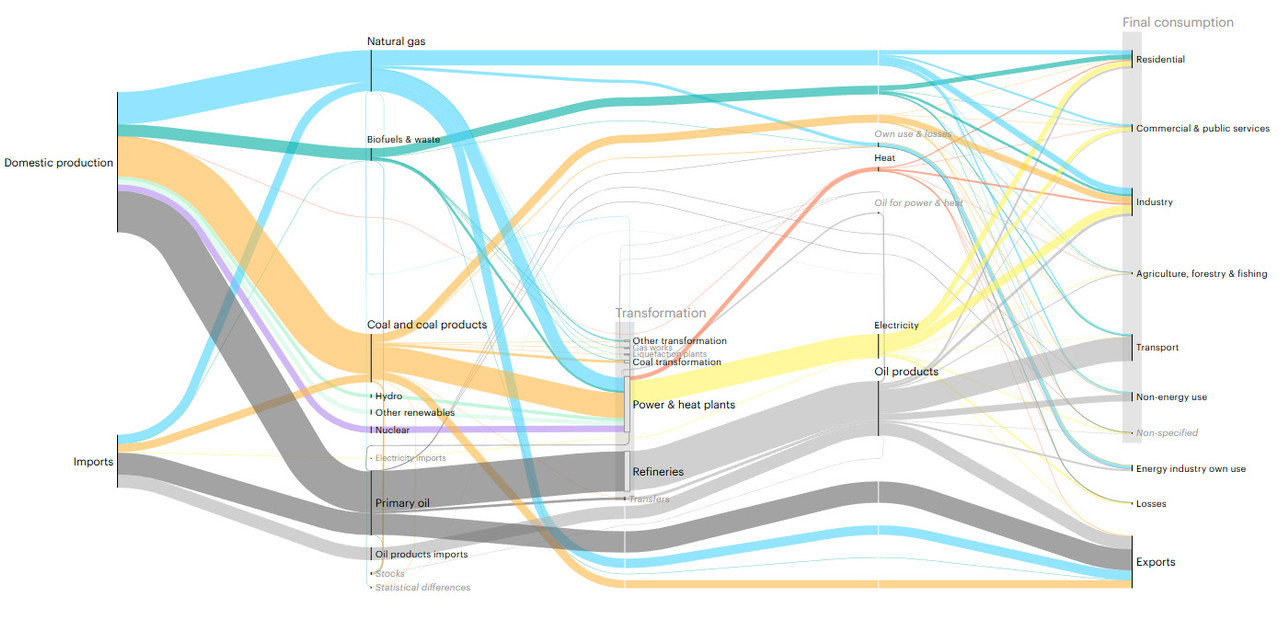
Now, I'm sure that people who think it's OK to waste electricity to charge batteries will announce that 2026 is very different than 2023, because well, it's three whole years later, perhaps by producing a tweet, but, being a scientist as opposed to a credulous rube, I'm unimpressed. The planet is burning and the numbers are clear even if the skies aren't.

Finishline42
(1,189 posts)Why wasn't the mix of power plants updated? The following is what I got from Google when I asked >>> current pjm installed fleet of power generation
The PJM Interconnection manages a vast regional grid spanning 13 states and the District of Columbia, comprising approximately 1,436 electric power generators with a total installed capacity of roughly 198,800 megawatts (MW).The PJM fleet relies primarily on natural gas, coal, and nuclear power, with a shifting focus on renewable integration:
Natural Gas: ~56,100 MW (approx. 28.2%), making it the largest block of generating capacity.
Coal: ~38,800 MW (approx. 19.5%). A large portion of the installed coal fleet (31,200+ MW) is over 40 years old and has been driving major fleet retirements.
Nuclear: ~33,500 MW (approx. 16.8%).
Renewables & Storage: ~4% to 5% of installed capacity. This is split among wind (~2%), solar (~1%), hydro, and a rapidly emerging (but still small) amount of battery storage.
The grid mix is undergoing a dramatic shift driven by data center load growth and aggressive coal retirements. PJM is processing hundreds of gigawatts of new generator interconnection requests, though the majority are waiting to clear supply chain and permitting hurdles to join the operational fleet.
Renewables play a very small part but what about customer installed solar? Is that counted? I ask because when EV owners install solar it pretty much eliminates the main premise of the study - that EV's create more pollution than ICE vehicles (reminds me of the internet claims that the Hummer was more environmentally friendly than a Prius).
NNadir
(38,869 posts)...one understands that it is not, nor is it intended to be, oracular.
Many papers cite others not in support but in criticism. This is the admirable but flawed system under which science functions.
Over 24,000 academic papers have been published in 2026 alone on the subject of power generation and we're only halfway through the year. Obviously some are better than others. Cherry picking among them is absurd without context.
The fact that there are bourgeois homeowners in danger of breaking their arms to pat themselves on the back for being "green," does not imply that their efforts are either significant nor even laudable or relevant to the larger world.
Electric cars for the bulk of humanity are not any more sustainable than other types of cars.
Batteries are not sustainable over the long term nor can they ever under any circumstances, be considered "green" because they destroy exergy and they represent infrastructure that can only be useful for relatively short periods. Their limited reliability depends on reliable sources of energy to charge them on demand. There is only one reliable source of clean energy and it is not solar, not even close.
Finishline42
(1,189 posts)I bought a 2021 Model Y, all wheel drive, extended range from Tesla in Dec 2023. Had 39,000 miles on it. Spent $37k
Today you can buy a similar Model Y for $30k. Mainly because of the advances in battery tech.
Ford's new Truck coming out in 2027 will start at $30k and use LFP batteries made under license from CATL.
LFT batteries?
An LFP battery is a Lithium Iron Phosphate (LiFePO4) rechargeable battery. Known for exceptional safety, longevity, and affordability, it uses iron and phosphate instead of expensive, conflict-prone materials like cobalt and nickel. It is widely used in electric vehicles and home solar storage.
NNadir
(38,869 posts)...personal experience.
I'm unimpressed.
I've been here for over 20 years listening to their self-congratulatory bullshit, telling me for instance how they like to go into their garage and watch their electric meters work in reverse, as if that matters.
It doesn't.
Meanwhile, on planet Earth, there are well over one billion people who lack basic sanitation and over 3 billion people who lack clean water, according to the UN link just produced.
The planet is burning.
Now there are lots of people around here, still this late in the game, who love to brag about funding the racist white supremacist Elon Musk with their junkie little cars, including those with batteries.
Nevertheless the planet is burning.
Don't worry, be happy. Those iron phosphate batteries are recyclable, always the magic term for antinukes looking to rip the land and seas to pieces for so called "renewable energy."
Cf: Yi Fan, Yongyou Su, Zitong Fei, Yuyun Li, Yun Luo, Le Tian, Qi Meng, Peng Dong, Progress and prospect of spent lithium iron phosphate cathode materials recycling: A review, Journal of Energy Storage, Volume 132, Part B, 2025, 117771.
I like this happy bit of text from the full paper:
How are those 800 °C temperatures going to be produced? Trashing a desert for solar concentration plants that run two hours a day if it's not cloudy?
We can get that lithium back for sure.
Then there's phosphorous, the 11th most abundant element on the planet.
Phosphorous is a critical element on which the world food supply depends, but I don't expect despite being listed as a critical element subject to depletion will be grotesquely enhanced by bourgeois airheads celebrating their worship of Musk and his ersatz "nobility" in setting his cobalt slaves free, even if the iron phosphate battery is less efficient and less robust than NMC batteries thus requiring even more energy losses to use them and hence, a requirement for even more generation. Over in solar electric car heaven I suspect there are few people who give a rat's ass about recycling polyvinylidene fluoride polymers contained in the cathodes of iron phosphate batteries, fluorocarbons representing one of the most intractable environmental problems before humanity, albeit well after the collapse of the planetary atmosphere because, among other things, most of the world's electricity is generated by the combustion of dangerous fossil fuels.
Most phosphate mining, now centered in Morocco, is designed for agricultural use, which has generated some remarks in the literature, for instance:
Illakwahhi, D.T., Vegi, M.R. & Srivastava, B.B.L. Phosphorus' future insecurity, the horror of depletion, and sustainability measures. Int. J. Environ. Sci. Technol. 21, 9265–9280 (2024).
From that paper's text:
Furthermore, (Cordell et al. 2009) predicted that phosphorus production would peak in 2033, after which production would decline, and the remaining reserves would have low-grade phosphorus (P2O5) content. And that extracting, shipping, and processing fertilizers from such low phosphorus content reserves would be expensive, making their fertilizers unaffordable, especially to small-scale farmers. These studies used Hubbert-style curve modelling, in which phosphate rock reserves and historical production data are fitted into mathematical functions to predict production peak and depletion timeframe (Koppelaar and Weikard 2013; Sverdrup and Ragnarsdottir 2011)...
Like most of this "renewable energy will save us" horseshit we hear all day long between ads for Tesla here, we obviously don't give a rat's ass about future generations.
Don't worry though, be happy. We have never hesitated to fuck with the food supply if it meant curtailing our love of cars. In the old days, we decided to kill the Mississippi River delta and kill off all of the seafood in the Gulf beyond it so we could put "renewable" ethanol in gasoline.
But I'm grotesquely overstating the risk to phosphorous supplies in connection with cars, since car worship is only a tiny fraction of the 3% of the world's phosphorous supply that is devoted to industrial use, including batteries. I'm sure we'll easily come across plenty of phosphorous to replace a billion or so cars and trucks with Ford and Tesla products and if the phosphorous is gone "by 2100" that's not our problem. We have never given a rat's ass about future generations other than to worry someone might get exposed to a radioactive element in the year 2525.
Nevertheless, phosphorous depletion has been observed, for instance in the totally strip mined nation of Nauru whose main industry after the phosphate ran out is now warehousing refugees deported from Australia.
What's magic Elon's plan for replacing the neodymium and dysprosium in magnets for the magic electric cars by the way? Going back to pure iron and nickel magnets, I guess.
Sigh...
The nice thing about lanthanide mines is that the tailings are radioactive as they contain thorium. I favor the recovery and use of that thorium with sustainable energy, which is not, in my view, solar and wind junk that will be landfill in 20 years.
We're so damned clueless, it's depressing.
The planet is still burning, but don't let that distract you from your love of your Model Y car provided by trillionaire Musk. I'm sure there are many people here who are happy for this sort of self declared "green nobility" even if I'm personally not impressed so much as disgusted.
Have a nice weekend.
Finishline42
(1,189 posts)
muriel_volestrangler
(106,864 posts)Since you say "WHO CARES?????? WE HAVE OUR CARS!!!! The indecency of our bourgeois class never seems to reach a bottom, does it", I presume it doesn't involve private vehicles. With what would you power the buses?
NNadir
(38,869 posts)muriel_volestrangler
(106,864 posts)You are an incurable optimist.
NNadir
(38,869 posts)I have thousands upon thousands of scientific papers on the subject of carbon dioxide in my personal files.
The one that sticks most prominently in my mind is the 2011 paper by Nobel Laureate George Olah, published in JACS 133, 33, 12881-12898 on closed carbon cycles. The paper is now 15 years old. It is obvious the advice was ignored.
I am not in my own opinion, an optimist. On the contrary, I regard myself as a cynical. I do believe that the capture of atmospheric carbon dioxide resides on the border between feasible and impossible, best by the intermediate agency of seawater. I do not however believe it will be accomplished. One should never underestimate the power of ignorance. Just look at the creature residing in the White House if you don't believe me.
One of the things present in all energy conversations, including this one, especially this one, is myopia.
muriel_volestrangler
(106,864 posts)You're wishing that no one does anything to use batteries, hydrogen, or any other means of powering transport, until your "on the border between feasible and impossible" capture of atmospheric CO2 has been achieved, even though your own preferred method of energy generation, nuclear fission, needs at least one of these means for a transport solution.
That's why I think you're a hopeless optimist. You want to bet the world on this technology being achieved, and think that ignoring other possibilities would be fine - you must think this carbon capture will turn up any day now.
Myopia? Yes.
NNadir
(38,869 posts)I am not about to abandon my conclusions based on whining about whether I'm insufferably optimistic or pessimistic or whether someone's opinion of what myopia might or might not be.
I became interested in nuclear energy in response to Chornobyl, and did so not as a supporter of nuclear energy but as a rather dogmatic critic of the enterprise, for which I took Chornobyl to be conclusive evidence.
When I joined DU in 2002, given that some 16 years later the consequences of Chornobyl were nowhere near the consequences of of the collapse of the planetary atmosphere from fossil fuel waste, I was then a supporter of so called "renewable energy." I was as ignorant as any antinuke here about whether the reactionary impulse to make energy as dependent on weather as agriculture is or was a good idea or not. I educated myself and I changed my mind.
This place is populated with antinukes and "I'm not an antinuke" antinukes still, all of whom apply criteria to nuclear energy that they apply to nothing else, not waste, not cost, not speed, not reliability, not carbon intensity and not the fossil fuels about which they don't give a rat's ass.
The price and environmental impact of energy, the latter often, correctly monetized as "external cost," should be obvious simply by comparing the poster boys and girls in antinuke heaven, Germany, and nuclear nirvana, France.
Whenever I point this out, usually with references including real numbers, I am met with soothsaying, denial and other quasireligious rhetoric.
Simple statements, the simplest of all possible if the 2nd law of thermodynamics, "changing the form of energy loses energy" is often met with oblivious chanting and/or logical fallacies such as poisoning the well and worse.
I am not interested at all in whether any individual regards me as myopic or not. I have a demonstrated history of changing my mind. My general perception is that there are lots of people here with the inability to do that, to change their minds.
I've been at that exercise, the exercise of seeing if my ideas stand up to scrutiny, for my entire adult life, half a century of it. I support my views and if I cannot support them, I change them. I've worked incredibly hard at developing my ideas in fits and starts. I am proud of the effort, and I am having the possibly undeserved pleasure of having a young person on the front lines of energy development to whom I can share and hand off my developed ideas, my son.
If we're going to talk about myopia, and I really don't give a shit to whom we apply that state, I would submit that we should notice that the planet is burning, the atmosphere is collapsing, entire ecosystems are disappearing and along with them supplies of fresh water, and still we wallow here, decade after decade taking about batteries, electric cars, solar cells and wind turbines, oblivious to the fact that trillions of dollars spent on them has done nothing to arrest this course.
Nuclear energy was discovered and developed by the greatest minds of the 20th century and largely rejected on criteria we don't apply to fossil fuels about danger and war and sustainability and so on. After half a century people are finally poring through the records of the work of these long dead great minds. The task of these highly educated people working to undo the historical rejection of this form of energy is incredibly difficult.
I admire these people. I'm sure the enormity of the task fills them with self doubt. To me they recall the challenge issued by my political heroine, Eleanor Roosevelt, "You must do the thing you think you cannot do."
I am fairly well convinced the situation is irretreivable, but I'm willing to be proved wrong after my death. I want to be proved wrong. That is called "hope." These people who can prove me wrong, including my son, may not do the the things they think they cannot do, but unless they make the enormous effort they will not know whether or not they were right or wrong on their doubts.
I myself have had the pleaure of being wrong, and I couldn't care less who respects that or not.
Have a nice day.