Science
Related: About this forumBuckminster Fuller - Everything I Know - Part 1
The stories behind his Dymaxion car, geodesic domes, World Game and integration of science and humanism are lucidly communicated with continuous reference to his synergetic geometry. Permeating the entire series is his unique comprehensive design approach to solving the problems of the world. Some of the topics Fuller covered in this wide ranging discourse include: architecture, design, philosophy, education, mathematics, geometry, cartography, economics, history, structure, industry, housing and engineering.
Watch the 170 videos at the link:
https://archive.org/details/buckminsterfullereverythingiknow01
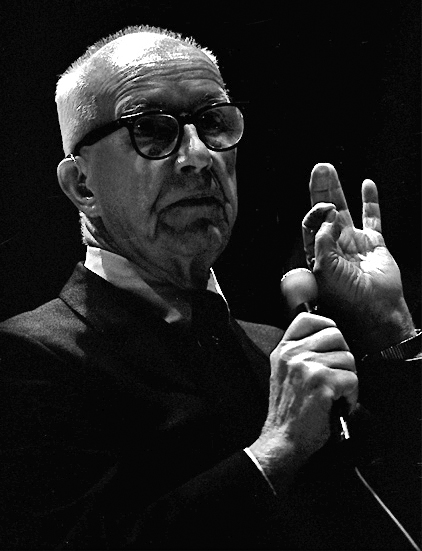 Fuller in 1972 Credit: Buckminster Fuller, 1972-1973 tour at UC Santa Barbara
Fuller developed numerous inventions, mainly architectural designs, and popularized the widely known geodesic dome; carbon molecules known as fullerenes were later named by scientists for their structural and mathematical resemblance to geodesic spheres. He also served as the second World President of Mensa International from 1974 to 1983.[2][3]
Fuller was awarded 28 United States patents[4] and many honorary doctorates. In 1960, he was awarded the Frank P. Brown Medal from the Franklin Institute. He was elected an honorary member of Phi Beta Kappa in 1967, on the occasion of the 50-year reunion of his Harvard class of 1917 (from which he had been expelled in his first year).[5][6] He was elected a Fellow of the American Academy of Arts and Sciences in 1968.[7] The same year, he was elected into the National Academy of Design as an Associate member. He became a full Academician in 1970, and he received the Gold Medal award from the American Institute of Architects the same year. Also in 1970, Fuller received the title of Master Architect from Alpha Rho Chi (APX), the national fraternity for architecture and the allied arts.[8] In 1976, he received the St. Louis Literary Award from the Saint Louis University Library Associates.[9][10] In 1977, he received the Golden Plate Award of the American Academy of Achievement.[11] He also received numerous other awards, including the Presidential Medal of Freedom, presented to him on February 23, 1983, by President Ronald Reagan.[12]
(...)
Philosophy
Buckminster Fuller was a Unitarian, and, like his grandfather Arthur Buckminster Fuller (brother of Margaret Fuller),[41][42] a Unitarian minister. Fuller was also an early environmental activist, aware of Earth's finite resources, and promoted a principle he termed "ephemeralization", which, according to futurist and Fuller disciple Stewart Brand, was defined as "doing more with less".[43] Resources and waste from crude, inefficient products could be recycled into making more valuable products, thus increasing the efficiency of the entire process. Fuller also coined the word synergetics, a catch-all term used broadly for communicating experiences using geometric concepts, and more specifically, the empirical study of systems in transformation; his focus was on total system behavior unpredicted by the behavior of any isolated components.
(...)
https://en.wikipedia.org/wiki/Buckminster_Fuller
 = new reply since forum marked as read
Highlight:
NoneDon't highlight anything
5 newestHighlight 5 most recent replies
= new reply since forum marked as read
Highlight:
NoneDon't highlight anything
5 newestHighlight 5 most recent replies
jfz9580m
(17,910 posts)Bookmarking for later



littlemissmartypants
(35,419 posts)
hunter
(40,942 posts)It was maybe fifteen minutes and he talked with everyone in our small group.
My mom was a fan and kept his book I Seem to be a Verb on her reference shelf.
I may have been a bit of a pest when Fuller and Kiyoshi Kuromiya were writing Critical Path but that's all I'll say, except that I was a complete lunatic then, not the partial lunatic I am now. When I had a question I could be unreasonably persistent in finding the answer.
In Critical Path Fuller envisions a worldwide electric grid and the kilowatt hour as the basis for a world currency. For a long time I found the proposal intriguing. Unfortunately the math doesn't work. It's very similar to proposed hydrogen economies in that respect. The synergies do not offset the financial or environmental costs.