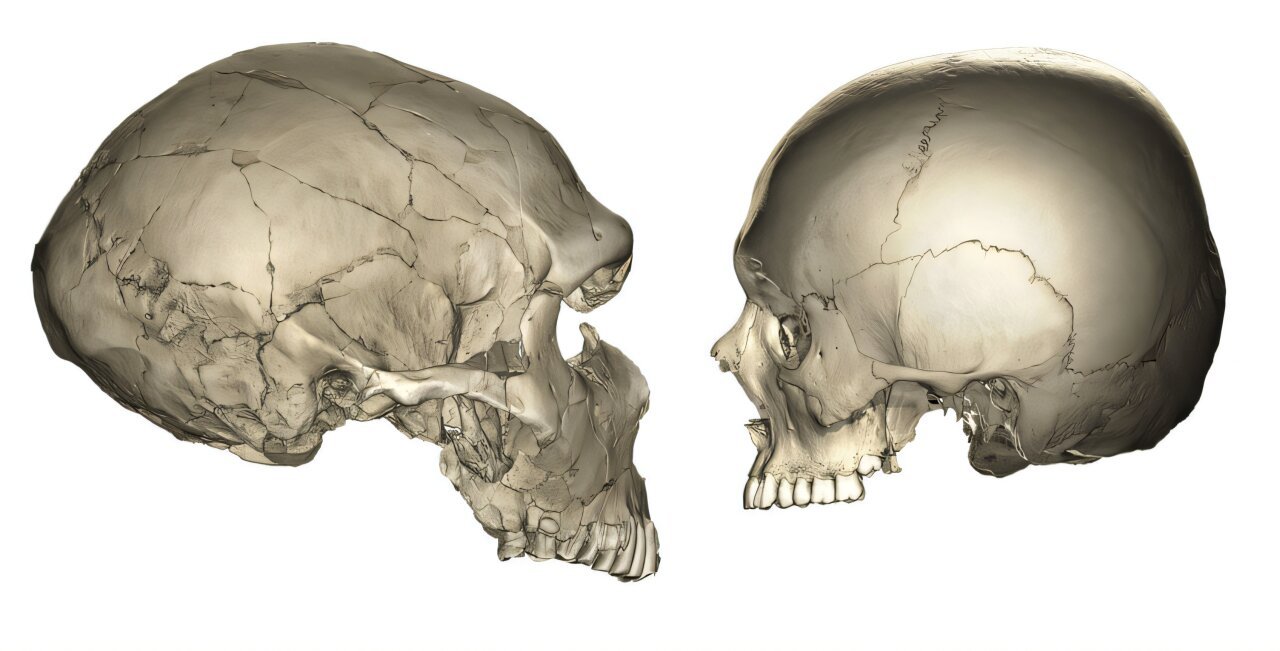
 The Evolution of the Human Face: Why It Became Smaller and More Delicate
Muhammad Tuhin
Science News Daily, March 27, 2025
The human face is strikingly distinct from that of our closest evolutionary relatives, such as Neanderthals and other ancient hominins. It is significantly smaller, more refined, and less robust compared to our fossil ancestors. While it is well known that our facial structure has evolved over thousands of years, the reasons behind this transformation have remained largely elusive.
A groundbreaking study led by researchers at the Max Planck Institute for Evolutionary Anthropology has shed light on this mystery, revealing that the human face became smaller due to a fundamental shift in growth patterns. Unlike Neanderthals and chimpanzees, whose faces continue to grow for a prolonged period, human facial growth halts much earlier—around adolescence. This shift in development has played a crucial role in shaping the unique facial characteristics of modern humans.
The Role of Development in Facial Evolution
“Our findings reveal that a change in development—particularly during late growth stages—led to smaller faces,” explains Alexandra Schuh, the study’s first author. “Compared to Neanderthals and chimpanzees who continue growing longer, human facial growth stops earlier, around adolescence, resulting in a smaller adult face.”
This difference in developmental timing, known as heterochrony, is one of the primary factors that differentiate Homo sapiens from our fossil cousins. By stopping facial growth earlier, humans developed a more gracile (delicate and refined) face, which contrasts sharply with the robust and protruding faces of Neanderthals.
Source:
https://www.sciencenewstoday.org/the-evolution-of-the-human-face-why-it-became-smaller-and-more-delicate

 = new reply since forum marked as read