Welcome to DU!
The truly grassroots left-of-center political community where regular people, not algorithms, drive the discussions and set the standards.
Join the community:
Create a free account
Support DU (and get rid of ads!):
Become a Star Member
Latest Breaking News
Editorials & Other Articles
General Discussion
The DU Lounge
All Forums
Issue Forums
Culture Forums
Alliance Forums
Region Forums
Support Forums
Help & Search
General Discussion
Showing Original Post only (View all)
Greenspan Was the Creator of His Own Disaster [View all]

The former Fed chair, who died at the age of 100 this week, deliberately engineered financial markets to be faster and looser. Then they blew up.
https://prospect.org/2026/06/24/alan-greenspan-creator-of-his-own-disaster/

As Federal Reserve Board chairman, Alan Greenspan testifies on Capitol Hill, January 25, 1995, before the Senate Finance Committee. Credit: John Duricka/AP Photo
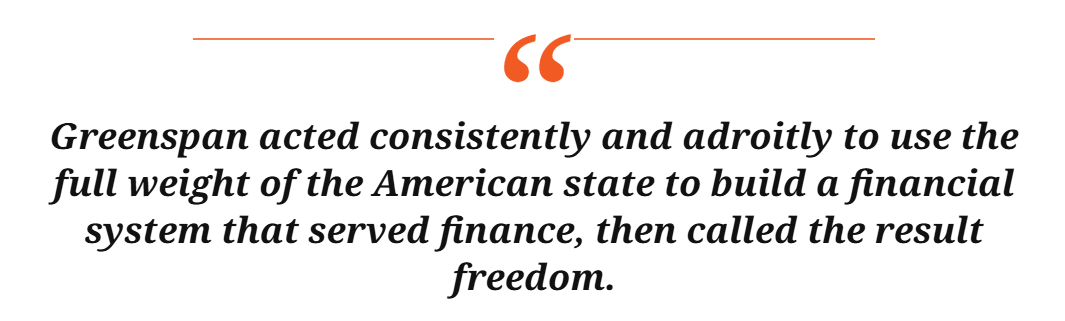
Alan Greenspan’s obituary writers want to credit him with a single, flattering flaw: that he trusted markets too much. That charge is too generous, because Greenspan never left markets to run themselves. He used the power of the Fed to cultivate and reward financial innovation, making the financial system more fragile for it. Often misunderstood as an Ayn Rand acolyte, Greenspan was not a true libertarian. His creed was not “leave the market alone” as much as it was to use the tools of the government to make the market faster and more inventive—and then stand by to catch it when it falls.
Those actions fueled the soaring inequality and the economic crash of 2008. Greenspan was no bystander watching markets obey some ineffable logic. His obsession with financial innovation set the stage for the crisis. Foundational to Greenspan’s outlook was the idea that financial innovation is the engine of the American economy: The easier it is to buy and sell an asset, the truer its price. Risk itself could be sliced up and sold off until, in theory, nobody was holding too much of it. “No market is ever truly unregulated,” he said. “The self-interest of market participants generates private market regulation.” Perhaps the clearest expression of the Greenspan belief that government must be mobilized to support financial innovation is the case of derivatives.
In the spring of 1998, the heaviest hitters in American economic policy crowded into a conference room at the Treasury to gang up on one woman. Brooksley Born ran the Commodity Futures Trading Commission, and she had committed the sin of noticing that the market in derivatives, custom bets whose value rides on the value of another asset, had swollen from roughly $4.5 trillion to $28 trillion within four years, with essentially no one watching. She didn’t want to ban them, but she did want basic rules to make the market more stable. Greenspan, Treasury Secretary Robert Rubin, his deputy Larry Summers, and SEC chair Arthur Levitt shut her down.
Greenspan played the ideologue: Regulation would smother innovation. “You can’t put the cork back in the bottle,” he told the room. He had once informed Born over lunch that he saw no need even for laws against fraud, since a crook would lose his customers soon enough. Born left with nothing to show for her concern. Summers later phoned Born, by her account, with a warning: “I have 13 bankers in my office and they say if you go forward with [derivatives rules] you will cause the worst financial crisis since World War II.” She resigned the next year, and Congress promptly passed a law stripping her agency of any authority over the exact instruments that would detonate in 2008. Five months after the meeting, a hedge fund called Long-Term Capital Management blew up on those very derivatives and needed a Fed-brokered rescue.
snip
10 replies
 = new reply since forum marked as read
Highlight:
NoneDon't highlight anything
5 newestHighlight 5 most recent replies
= new reply since forum marked as read
Highlight:
NoneDon't highlight anything
5 newestHighlight 5 most recent replies
= new reply since forum marked as read
Highlight:
NoneDon't highlight anything
5 newestHighlight 5 most recent replies