Environment & Energy
In reply to the discussion: As E15 Gas Becomes More Common, Remember That It's Terrible For These Engines [View all]
ffr
(23,428 posts)That's your reference? A blog? Where are your authoritative references? 
I'm going to impeach what you use as your reference, which I assume is where you're getting your facts from. 
Case in point: This unique fuel possesses distinctive characteristics. Notably, it is hygroscopic, absorbing moisture from the atmosphere, which can lead to storage challenges and accelerated corrosion in fuel tanks.
Stating that ethanol is hygroscopic by definition impeaches your earlier claim about not violating basic Chemistry 101. Ethanol is defined in chemistry as a covalent hydrophilic (1) polar molecule. You should understand these terms.
Hydrophilic means water loving, dissolves in "liquid" water.
Polar means the molecule is electrically charged, with distinct positive and negative charged regions
Covalent means that it shares electrons between atoms
But also, ethanol's ability to absorb water is temperature dependent
What defines a hyrgroscopic element for this discussion? They are substances that tend to absorb water vapor from the air. So, what are commonly used substances for drawing water vapor from the air? Desiccants - Calcium chloride, calcium sulfate, activated carbon, zeolites and silica gel are all common desiccants.
Hygroscopic Zeolite molecule
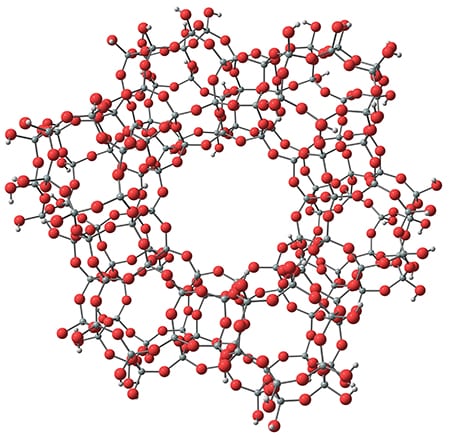
Hygroscopic Desiccant silica gels

What defines these Ionic substances? They are:
Metals or near metals on the periodic table
Highly polar molecules
Is ethanol a metal or near metal? No.
Is ethanol highly polar? No.
Is ethanol an ionic molecule? No.
Is ethanol temperature dependent in how much water it can absorb? Yes.
Hydrophilic Ethanol molecule
 ?w=768
Can ethanol still have hygroscopic properties? Yes. But just as hydrophobic octane hydrocarbons can absorb traces of water vapor from the air, it simply means given enough time and it will take a lot of time, if you're using ethanol to absorb water vapor from the air, you're going about that solution all wrong. Ethanol it is poorly hygroscopic. You should use an ionic compound to absorb water vapor.
Impeaching your other highlighted point at the bottom about gasoline phase separation. I guess you failed to read the whole study. - Thus, this was what was found in a Water Phase Separation in Oxygenated Gasoline study. Pgs 1 and 4 - 5
Introduction - While separate water phases in a fuel can be damaging to an engine, small amounts of water in solution with gasoline should have no adverse effects on engine components...
Another way water can enter gasoline is through absorption from the air. Water, in the form of water vapor, can dissolve in gasoline. The more humid the air, the faster the water vapor will dissolve in the gasoline. Due to chemical equilibrium, however, assuming a constant temperature, phase separation will never occur if the only source of water is from the air. Only enough water to saturate the fuel can enter the system, and no more. Water vapor, however, dissolves in gasoline very slowly, even at very high humidity. For example, at a constant temperature of 100 degrees F and relative humidity of 100%, it would take well over 200 days to saturate one gallon of gasoline in an open gasoline can (assuming the only source of water is water vapor from the air). Water absorption from the air is far slower at lower temperatures and humidities. (At a temperature of 70 degrees and relative humidity of 70%, it would take over two years to saturate one gallon of conventional gasoline in the same gasoline can.) Again, oxygenated gasolines can hold more water than conventional gasoline, and would therefore take much longer to saturate with water.
To further impeach what you refer to ethanol's engine damaging phase separation, ignores the fact about conventional gasoline, the other gasoline that does not contain ethanol. By definition phase separation is when something separates into two or more separate phases. Ethanol-free E0 gasoline contains no ethanol. Right? There's no hydrophilic ethanol in conventional E0 gasoline. Hydrocarbon gasoline is hydrophobic, water hating. What do you think happens with the corrosive water condensation that occurs in fuel tanks with only ethanol free conventional gasoline? If you guessed that after sloshing with the water droplets the gasoline settled at the top and the water settled at the bottom, you'd be correct. Water, as in the old water-doesn't-mix-with-oil analogy, settles to the bottom IN A STRATIFIED PHASE SEPARATED LAYER. So, by your definition of why ethanol can damage an engine, because it can phase separate with water, then how damaging is running straight water through your engine that's at the bottom of a fuel tank with conventional gasoline going to be when it's picked up from the fuel tank's sump pickup?

1 - Water and alcohols have similar properties because water molecules contain hydroxyl groups that can form hydrogen bonds with other water molecules and with alcohol molecules, and likewise alcohol molecules can form hydrogen bonds with other alcohol molecules as well as with water. Because alcohols form hydrogen bonds with water, they tend to be relatively soluble in water. The hydroxyl group is referred to as a hydrophilic (“water-loving”) group, because it forms hydrogen bonds with water and enhances the solubility of an alcohol in water. Methanol, ethanol, n-propyl alcohol, isopropyl alcohol, and t-butyl alcohol are all miscible with water. Alcohols with higher molecular weights tend to be less water-soluble, because the hydrocarbon part of the molecule, which is hydrophobic (“water-hating”), is larger with increased molecular weight.
Edit history
Recommendations
0 members have recommended this reply (displayed in chronological order): = new reply since forum marked as read
Highlight:
NoneDon't highlight anything
5 newestHighlight 5 most recent replies
RecommendedHighlight replies with 5 or more recommendations
= new reply since forum marked as read
Highlight:
NoneDon't highlight anything
5 newestHighlight 5 most recent replies
RecommendedHighlight replies with 5 or more recommendations