In the diagram in the tweet you’ve linked to, you’re seeing an example of “peak shaving,” Surplus solar power, generated at peak times, is stored for a few hours, and released, to help level off the supply. NREL experimented with storing hot molten salt to level off output from a concentrating solar plant in the Southwest, taking multiple factors into account, they found that about 8 hours of storage was optimal. Most BESS farms are well short of that, but, let’s pretend we can get 24 hours of level power out of all variable sources, like solar and wind.
What if there is an extended period of time (say, a few days or more) when conditions are not well suited to generation? (i.e. a “renewable energy drought.”)
Bracken, C., Voisin, N., Mongird, K., Burleyson, C. D., & Oikonomou, K. (2025). Intensifying renewable energy droughts in the Western U.S. amid evolving infrastructure and climate. Earth's Future, 13, e2024EF005313. https://doi.org/10.1029/2024EF005313
…
Abstract
If renewable energy resources continue to become a larger part of the generation mix in the United States (U.S.), so does the potential impact of prolonged periods of low wind and solar generation, known as variable renewable energy (VRE) droughts. In such a future, naturally occurring VRE droughts need to be evaluated for their potential impact on grid reliability. This study is the first of its kind to examine the impacts of compound VRE energy droughts in the Western U.S. across a range of potential future climate and infrastructure scenarios. We find that compound VRE drought severity may increase significantly in the future, primarily due to the dramatic increase in wind and solar generation needed in some future infrastructure scenarios. We find that in our future climate scenario, the variability of energy drought severity increases, which has implications for sizing energy storage necessary for mitigating drought events. We also examine the spatial patterns of compound VRE drought events that effect multiple regions of the grid simultaneously. These co-occurring events have distinct spatial patterns depending on the season. We observed overall fewer connected events in the future with the combined effect of potential climate and infrastructure changes, although in the fall we observe a climate-induced shift toward events which impact more regions simultaneously.
…
Here in New York State, we go through extended periods of time when there is less solar radiation available, so much so (in fact) that we experience much colder temperatures, since the sun is not providing as much heat. We call this phenomenon, “Winter.”
Here’s a handy graph for London (they’re at a similar latitude):

PV Solar does not become
useless in the Winter, merely
much less useful. This is a bit of a cruel irony; just when people need the most energy to heat buildings, there’s much less solar power available to do it with. This is
not something which you can cover with a few hours worth of battery capacity.
Some sort of seasonal storage is necessary.
One possibility which has been suggested for years is hydrogen, however, that presents challenges of its own.
Most experts point to some “
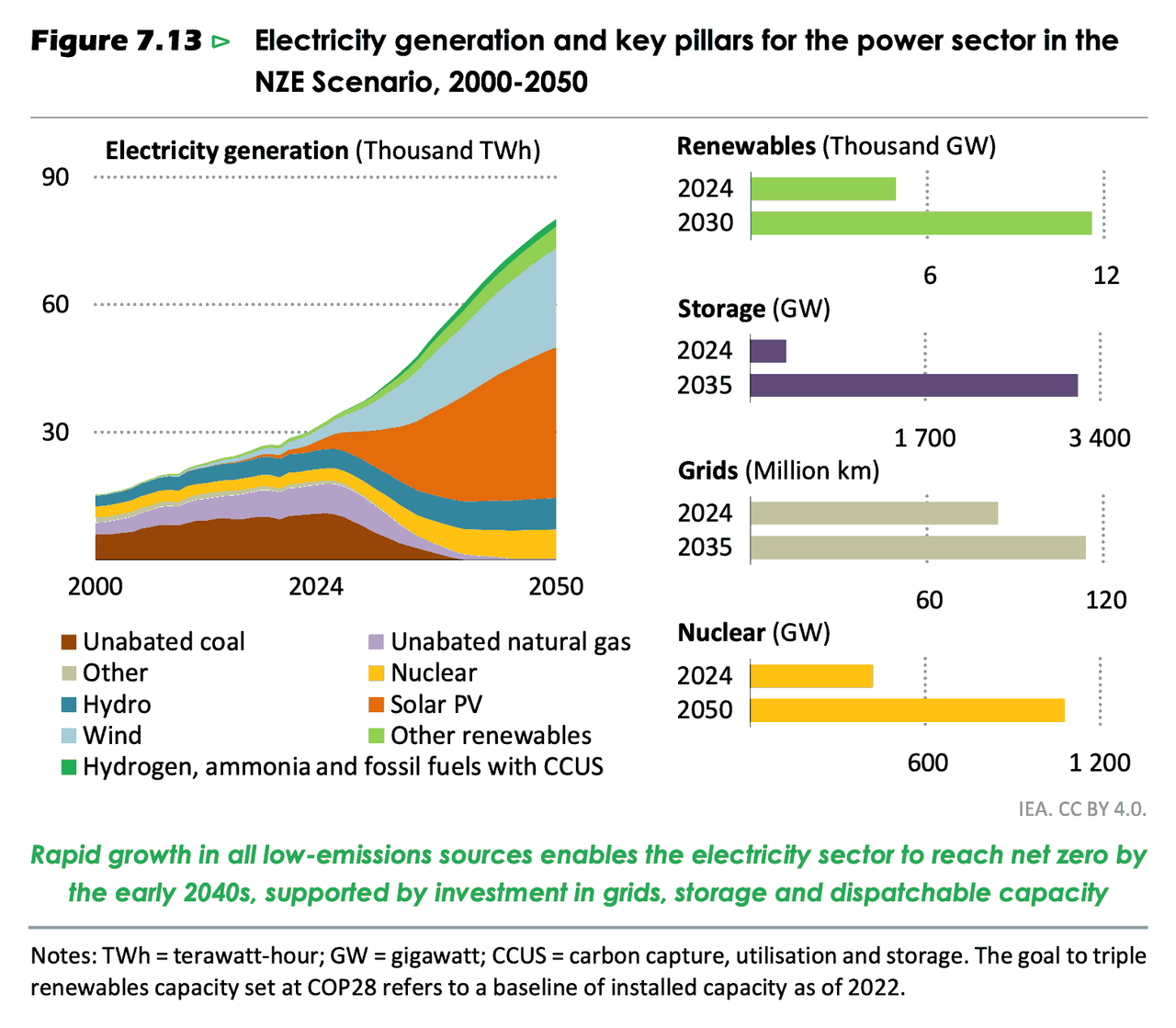
dispatchable generation," that can act as backstop for variable renewable energy. Clearly, we would prefer it not be fossil fuels (although for a time this is likely.) More and more, we would want to see
clean dispatchable sources, (e.g. nuclear fission, nuclear fusion) resulting in a grid that looks like this, where variable renewables dominate generation, with nuclear providing about the same amount as “hydro” (which is
also “dispatchable” to an extent.)
IEA (2025), World Energy Outlook 2025, IEA, Paris https://www.iea.org/reports/world-energy-outlook-2025, Licence: CC BY 4.0 (report); CC BY NC SA 4.0 (Annex A)

 = new reply since forum marked as read