Welcome to DU!
The truly grassroots left-of-center political community where regular people, not algorithms, drive the discussions and set the standards.
Join the community:
Create a free account
Support DU (and get rid of ads!):
Become a Star Member
Latest Breaking News
Editorials & Other Articles
General Discussion
The DU Lounge
All Forums
Issue Forums
Culture Forums
Alliance Forums
Region Forums
Support Forums
Help & Search

Buckminster Fuller - Everything I Know - Part 1 [View all]
During his entire life's work. These thinking out loud lectures span 42 hours and examine in depth all of Fuller's major inventions and discoveries from the 1927 Dymaxion house, car and bathroom, through the Wichita House, geodesic domes, and tensegrity structures, as well as the contents of Synergetics. Autobiographical in parts, Fuller recounts his own personal history in the context of the history of science and industrialization.
The stories behind his Dymaxion car, geodesic domes, World Game and integration of science and humanism are lucidly communicated with continuous reference to his synergetic geometry. Permeating the entire series is his unique comprehensive design approach to solving the problems of the world. Some of the topics Fuller covered in this wide ranging discourse include: architecture, design, philosophy, education, mathematics, geometry, cartography, economics, history, structure, industry, housing and engineering.
Watch the 170 videos at the link:
https://archive.org/details/buckminsterfullereverythingiknow01
The stories behind his Dymaxion car, geodesic domes, World Game and integration of science and humanism are lucidly communicated with continuous reference to his synergetic geometry. Permeating the entire series is his unique comprehensive design approach to solving the problems of the world. Some of the topics Fuller covered in this wide ranging discourse include: architecture, design, philosophy, education, mathematics, geometry, cartography, economics, history, structure, industry, housing and engineering.
Watch the 170 videos at the link:
https://archive.org/details/buckminsterfullereverythingiknow01
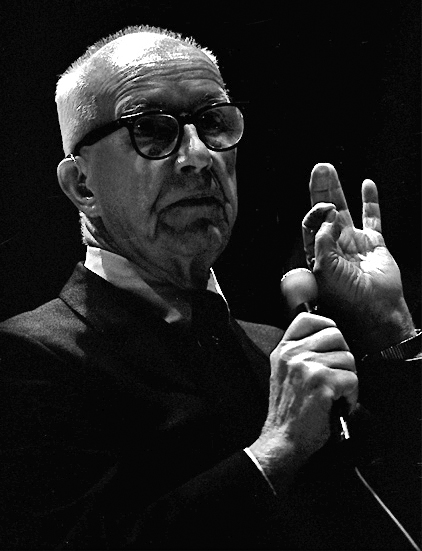 Fuller in 1972 Credit: Buckminster Fuller, 1972-1973 tour at UC Santa Barbara
Richard Buckminster Fuller Jr. (/ˈfʊlər/; July 12, 1895 – July 1, 1983)[1] was an American architect, systems theorist, writer, designer, inventor, philosopher, and futurist. He styled his name as R. Buckminster Fuller in his writings, publishing more than 30 books and coining or popularizing such terms as "Spaceship Earth", "Dymaxion" (e.g., Dymaxion house, Dymaxion car, Dymaxion map), "ephemeralization", "synergetics", and "tensegrity".
Fuller developed numerous inventions, mainly architectural designs, and popularized the widely known geodesic dome; carbon molecules known as fullerenes were later named by scientists for their structural and mathematical resemblance to geodesic spheres. He also served as the second World President of Mensa International from 1974 to 1983.[2][3]
Fuller was awarded 28 United States patents[4] and many honorary doctorates. In 1960, he was awarded the Frank P. Brown Medal from the Franklin Institute. He was elected an honorary member of Phi Beta Kappa in 1967, on the occasion of the 50-year reunion of his Harvard class of 1917 (from which he had been expelled in his first year).[5][6] He was elected a Fellow of the American Academy of Arts and Sciences in 1968.[7] The same year, he was elected into the National Academy of Design as an Associate member. He became a full Academician in 1970, and he received the Gold Medal award from the American Institute of Architects the same year. Also in 1970, Fuller received the title of Master Architect from Alpha Rho Chi (APX), the national fraternity for architecture and the allied arts.[8] In 1976, he received the St. Louis Literary Award from the Saint Louis University Library Associates.[9][10] In 1977, he received the Golden Plate Award of the American Academy of Achievement.[11] He also received numerous other awards, including the Presidential Medal of Freedom, presented to him on February 23, 1983, by President Ronald Reagan.[12]
(...)
Philosophy
Buckminster Fuller was a Unitarian, and, like his grandfather Arthur Buckminster Fuller (brother of Margaret Fuller),[41][42] a Unitarian minister. Fuller was also an early environmental activist, aware of Earth's finite resources, and promoted a principle he termed "ephemeralization", which, according to futurist and Fuller disciple Stewart Brand, was defined as "doing more with less".[43] Resources and waste from crude, inefficient products could be recycled into making more valuable products, thus increasing the efficiency of the entire process. Fuller also coined the word synergetics, a catch-all term used broadly for communicating experiences using geometric concepts, and more specifically, the empirical study of systems in transformation; his focus was on total system behavior unpredicted by the behavior of any isolated components.
(...)
https://en.wikipedia.org/wiki/Buckminster_Fuller
Fuller developed numerous inventions, mainly architectural designs, and popularized the widely known geodesic dome; carbon molecules known as fullerenes were later named by scientists for their structural and mathematical resemblance to geodesic spheres. He also served as the second World President of Mensa International from 1974 to 1983.[2][3]
Fuller was awarded 28 United States patents[4] and many honorary doctorates. In 1960, he was awarded the Frank P. Brown Medal from the Franklin Institute. He was elected an honorary member of Phi Beta Kappa in 1967, on the occasion of the 50-year reunion of his Harvard class of 1917 (from which he had been expelled in his first year).[5][6] He was elected a Fellow of the American Academy of Arts and Sciences in 1968.[7] The same year, he was elected into the National Academy of Design as an Associate member. He became a full Academician in 1970, and he received the Gold Medal award from the American Institute of Architects the same year. Also in 1970, Fuller received the title of Master Architect from Alpha Rho Chi (APX), the national fraternity for architecture and the allied arts.[8] In 1976, he received the St. Louis Literary Award from the Saint Louis University Library Associates.[9][10] In 1977, he received the Golden Plate Award of the American Academy of Achievement.[11] He also received numerous other awards, including the Presidential Medal of Freedom, presented to him on February 23, 1983, by President Ronald Reagan.[12]
(...)
Philosophy
Buckminster Fuller was a Unitarian, and, like his grandfather Arthur Buckminster Fuller (brother of Margaret Fuller),[41][42] a Unitarian minister. Fuller was also an early environmental activist, aware of Earth's finite resources, and promoted a principle he termed "ephemeralization", which, according to futurist and Fuller disciple Stewart Brand, was defined as "doing more with less".[43] Resources and waste from crude, inefficient products could be recycled into making more valuable products, thus increasing the efficiency of the entire process. Fuller also coined the word synergetics, a catch-all term used broadly for communicating experiences using geometric concepts, and more specifically, the empirical study of systems in transformation; his focus was on total system behavior unpredicted by the behavior of any isolated components.
(...)
https://en.wikipedia.org/wiki/Buckminster_Fuller
3 replies
 = new reply since forum marked as read
Highlight:
NoneDon't highlight anything
5 newestHighlight 5 most recent replies
= new reply since forum marked as read
Highlight:
NoneDon't highlight anything
5 newestHighlight 5 most recent replies
= new reply since forum marked as read
Highlight:
NoneDon't highlight anything
5 newestHighlight 5 most recent replies