Welcome to DU!
The truly grassroots left-of-center political community where regular people, not algorithms, drive the discussions and set the standards.
Join the community:
Create a free account
Support DU (and get rid of ads!):
Become a Star Member
Latest Breaking News
Editorials & Other Articles
General Discussion
The DU Lounge
All Forums
Issue Forums
Culture Forums
Alliance Forums
Region Forums
Support Forums
Help & Search
OKIsItJustMe
OKIsItJustMe's Journal
May 20, 2026
IEA: Net Zero Emissions by 2050 - Acting now to limit overshoot
Please note: this is quoted from a Creative Commons source:
IEA (2025), World Energy Outlook 2025, IEA, Paris https://www.iea.org/reports/world-energy-outlook-2025, Licence: CC BY 4.0 (report); CC BY NC SA 4.0 (Annex A)
S U M M A R Y
- The Paris Agreement set the global goal of limiting warming to well below 2 °C and pursuing efforts to limit it to 1.5 °C. The IEA Net Zero Emissions by 2050 (NZE) Scenario translates the 1.5 °C goal into a global pathway for the energy sector. The updated NZE Scenario presented here takes account of the most recent data and trends. Each country will tailor its own path to net zero emissions. The updated NZE Scenario is based on four central pillars that are widely applicable: clean energy electrification, energy efficiency, low-emissions fuels and methane abatement.
- The installed capacity of renewables increases nearly fourfold from todays level by 2035 in the NZE Scenario: nuclear and other low-emissions technologies increasingly contribute as electricity demand grows to account for one-third of all energy consumption. Energy efficiency increases by about 4% per year by 2035, double the rate of 2022. Sustainable fuels including liquid biofuels, biogases, low-emissions hydrogen and hydrogen-based fuels are widely deployed: their use more than quadruples by 2035 from current levels. Methane emissions are cut by more than 80% by 2035.
- Global energy-related carbon dioxide (CO₂) emissions were 38 gigatonnes (Gt) in 2024. In the NZE Scenario, emissions fall by nearly 55% by 2035 to around 18 Gt. Yet, the increase in long-term global average temperature exceeds 1.5 °C around 2030 and peaks at around 1.65 °C about 2050. The NZE Scenario achieves the COP28 goals of doubling efficiency and tripling renewables capacity by 2030, and it meets the Paris Agreement goal of holding warming well below 2 °C throughout the 21st Century.
- The updated NZE Scenario reflects the fact that exceeding 1.5 °C is now inevitable, and some reliance on technologies to remove CO₂ from the atmosphere is unavoidable to return warming to below 1.5 °C. Such technologies are expensive and unproven at scale: immediate action to reduce emissions can limit the scale of the removals needed. In the NZE Scenario, the global average temperature increase falls back below 1.5 °C by 2100.
- Energy investment in the NZE Scenario increases to around USD 4.8 trillion per year over the next decade, from USD 3.3 trillion today. As these upfront investments are made, savings from lower fuel prices together with efficiency gains mean that households face costs for energy services comparable to those of today through to 2035, and lower still in the longer term. Fuel importers benefit too as import bills are cut by about two-thirds. Electricity takes on a bigger role to meet energy demand, underlining the significance of electricity security, and the need for secure and diversified supply chains for critical minerals and energy technologies.
May 7, 2026

Hansen, J., M. Sato, P. Hearty, R. Ruedy, M. Kelley, V. Masson-Delmotte, G. Russell, G. Tselioudis, J. Cao, E. Rignot, I. Velicogna, B. Tormey, B. Donovan, E. Kandiano, K. von Schuckmann, P. Kharecha, A.N. Legrande, M. Bauer, and K.-W. Lo, 2016: Ice melt, sea level rise and superstorms:/ evidence from paleoclimate data, climate modeling, and modern observations that 2 C global warming could be dangerous Atmos. Chem. Phys., 16, 3761-3812. doi:10.5194/acp-16-3761-2016.
Rapidly melting Antarctic ice shelves may cause global sea levels to rise far faster than expected - new study
https://ic3.uit.no/news/hattermann-sea-level-riseMay 7th, 2026
Global sea levels may rise faster than previously expected, a new study suggests. The reason is that warming oceans appear to be melting Antarctic ice shelves from below much more rapidly than expected.
Ice shelves, which are extensions of gigantic glaciers that float on the water surface, act like buttresses that slow the flow of gigatons of ice into the sea.
Now, researchers have discovered that long, channel-like grooves on the underside of these ice shelves can trap relatively warm ocean water. This sharply increases local melting.
The study has global implications. If Antarctic ice shelves thin and weaken, the downhill journey of the ice behind them can accelerate, fast-forwarding the process in which huge amounts of ice cascade into the ocean, causing sea levels worldwide to rise far faster than currently projected.
This dynamic has already been observed elsewhere in Antarctica. The Intergovernmental Panel on Climate Change (IPCC) has flagged polar ice shelf instability as a major but poorly understood risk factor that could lead to sea level rise that is far more rapid and severe than most current models predict.

Zhou, Q., Hattermann, T., Zhao, C. et al. Channelized topography amplifies melt-sensitivity of cold Antarctic ice shelves. Nat Commun 17, 3790 (2026). https://doi.org/10.1038/s41467-026-71828-8
Global sea levels may rise faster than previously expected, a new study suggests. The reason is that warming oceans appear to be melting Antarctic ice shelves from below much more rapidly than expected.
Ice shelves, which are extensions of gigantic glaciers that float on the water surface, act like buttresses that slow the flow of gigatons of ice into the sea.
Now, researchers have discovered that long, channel-like grooves on the underside of these ice shelves can trap relatively warm ocean water. This sharply increases local melting.
The study has global implications. If Antarctic ice shelves thin and weaken, the downhill journey of the ice behind them can accelerate, fast-forwarding the process in which huge amounts of ice cascade into the ocean, causing sea levels worldwide to rise far faster than currently projected.
This dynamic has already been observed elsewhere in Antarctica. The Intergovernmental Panel on Climate Change (IPCC) has flagged polar ice shelf instability as a major but poorly understood risk factor that could lead to sea level rise that is far more rapid and severe than most current models predict.


Hansen, J., M. Sato, P. Hearty, R. Ruedy, M. Kelley, V. Masson-Delmotte, G. Russell, G. Tselioudis, J. Cao, E. Rignot, I. Velicogna, B. Tormey, B. Donovan, E. Kandiano, K. von Schuckmann, P. Kharecha, A.N. Legrande, M. Bauer, and K.-W. Lo, 2016: Ice melt, sea level rise and superstorms:/ evidence from paleoclimate data, climate modeling, and modern observations that 2 C global warming could be dangerous Atmos. Chem. Phys., 16, 3761-3812. doi:10.5194/acp-16-3761-2016.
May 2, 2026
World Nuclear Association - Hydrogen Production and Uses
From the Anti-Nukes at the World Nuclear Association.
https://world-nuclear.org/information-library/energy-and-the-environment/hydrogen-production-and-uses
Hydrogen Production and Uses
UPDATED FRIDAY, 17 MAY 2024
- Hydrogen is increasingly seen as a key component of future energy systems if it can be made without carbon dioxide emissions.
- It is starting to be used as a transport fuel, despite the need for high-pressure containment.
- The use of hydrogen in the production of liquid transport fuels from crude oil is increasing rapidly, and is vital where tar sands are the oil source.
- Hydrogen can be combined with carbon dioxide to make methanol or dimethyl ether (DME) which are important transport fuels.
May 1, 2026
IEA (2025), World Energy Outlook 2025, IEA, Paris https://www.iea.org/reports/world-energy-outlook-2025, Licence: CC BY 4.0 (report); CC BY NC SA 4.0 (Annex A)
IEA - Energy pathways in the NZE Scenario
(Please note: The following content is taken from a Creative Commons source.)
IEA (2025), World Energy Outlook 2025, IEA, Paris https://www.iea.org/reports/world-energy-outlook-2025, Licence: CC BY 4.0 (report); CC BY NC SA 4.0 (Annex A)
7.3 Energy pathways in the NZE Scenario
The NZE Scenario illustrates a possible global path to the goal of net zero emissions by 2050. Each country will have its own pathway, depending on their circumstances. The energy transition set out in the NZE Scenario has four main pillars: deployment of low-emissions sources of electricity and electrification to reduce emissions in end-uses; improvements in energy efficiency; use of low-emissions fuels such as hydrogen, biofuels, and CCUS; and reductions in methane emissions. These strategies rapidly reduce emissions and drive a demand-led transition away from fossil fuels in this scenario.
7.3.1 Clean electrification
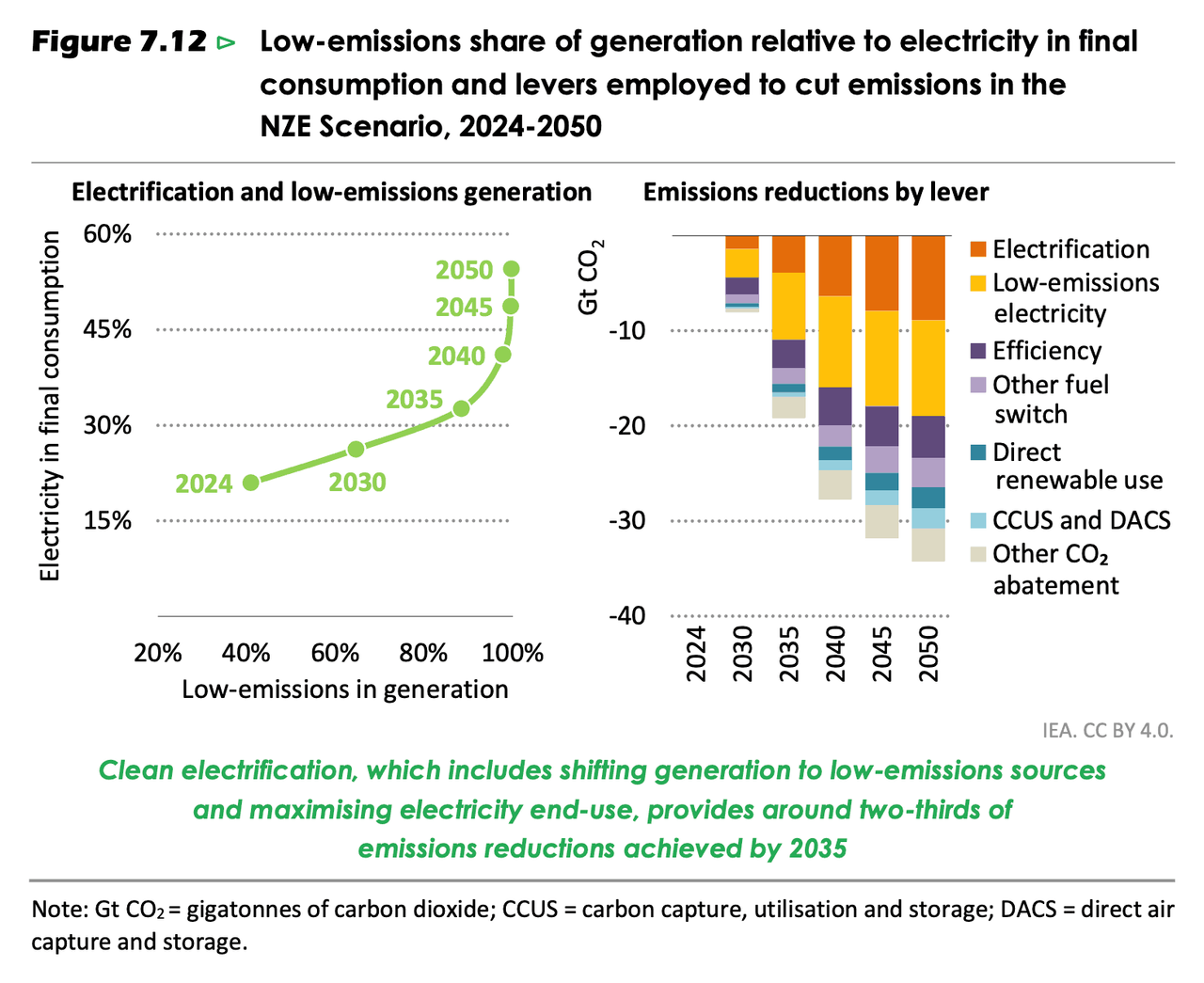
Today, the power sector accounts for about 40% of global energy-related emissions. Shifting electricity generation to low-emissions sources and increasing the deployment of lowemissions electricity in existing and new end-uses are central to the NZE Scenario: these strategies give rise to around two-thirds of the emissions reductions to 2035 (Figure 7.12). In the NZE Scenario, low-emissions sources provide nearly all electricity generation by 2040, while electricity increases its share in total final consumption to around 40% by 2040 and 55% by 2050. The expanding role of electricity in total final consumption and the increase in electricity supply from variable renewable sources underline the importance of electricity security in the NZE Scenario.
Generating electricity with low-emissions sources
Low-emissions sources of electricity renewables, nuclear, fossil fuels with CCUS, hydrogen and ammonia accounted for just over 40% of global electricity generation in 2024, up from around 30% a decade ago. Renewables were responsible for 32% of power generation worldwide, and nuclear for around 9%: there was also a very small contribution of less than 0.003% from fossil fuels equipped with CCUS.
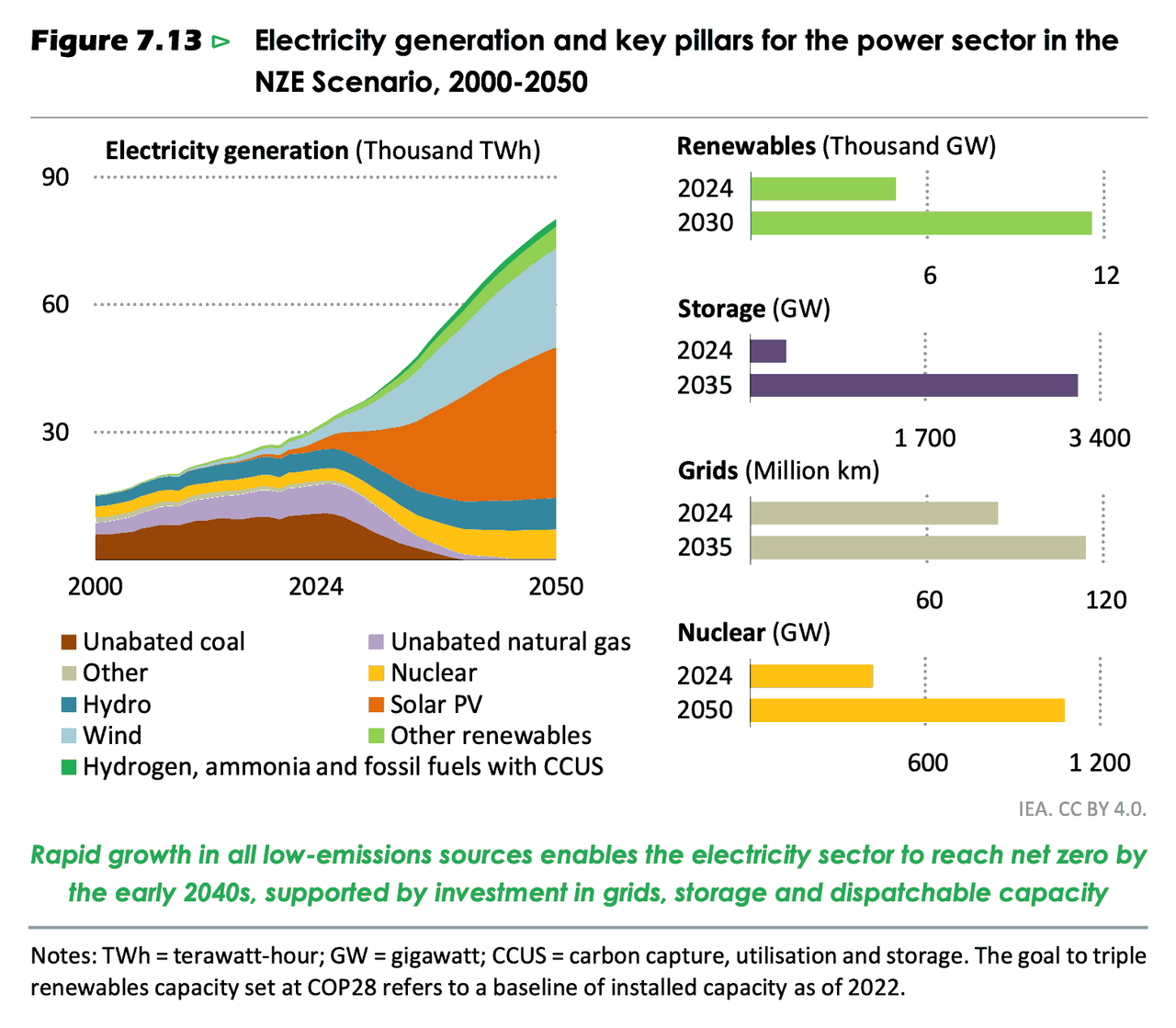
Global installed capacity of renewables triples to 2030 from a 2022 baseline in the NZE Scenario, building on the strong momentum already seen in the power sector, and meeting the goal set at COP28 in 2023 (Figure 7.13). As a result, renewables expand from around one-third of total generation today to around three-quarters by 2035. Achieving this while maintaining electricity security means ensuring that investment in electricity system flexibility keeps pace. Having surged by over 80% in 2024, the installed capacity of stationary batteries increases 17-fold to 2035, average of 30% per year, reaching almost 2 900 gigawatts (GW) in capacity terms and more than 8 400 gigawatt-hours (GWh) in energy terms. In the NZE Scenario, investment surges in grid infrastructure, and around 30 million kilometres (km) of new transmission and distribution lines are added by 2035.
As variable renewables such as solar PV and wind account for a rising share of generation, dispatchable capacity plays a critical role to ensure electricity security. Long lead-times for nuclear limits its role in the near term, but installed nuclear capacity in the NZE Scenario increases 70% by 2035 from the current level, and by 2050 it is two-and-a-half times higher. By the 2030s, the nuclear industry delivers annual additions of around 40 GW per year (Box 7.3). Hydropower capacity also expands strongly, with generation increasing more than 1.5-times by 2050. Unabated fossil fuel plants are operated increasingly for flexibility and capacity adequacy, and consequently their installed capacity falls more slowly than their output across the Outlook period. Fossil fuel plants equipped with CCUS and plants fired with hydrogen or ammonia are also deployed, providing additional low-emissions dispatchable capacity.
The NZE Scenario illustrates a possible global path to the goal of net zero emissions by 2050. Each country will have its own pathway, depending on their circumstances. The energy transition set out in the NZE Scenario has four main pillars: deployment of low-emissions sources of electricity and electrification to reduce emissions in end-uses; improvements in energy efficiency; use of low-emissions fuels such as hydrogen, biofuels, and CCUS; and reductions in methane emissions. These strategies rapidly reduce emissions and drive a demand-led transition away from fossil fuels in this scenario.
7.3.1 Clean electrification
Today, the power sector accounts for about 40% of global energy-related emissions. Shifting electricity generation to low-emissions sources and increasing the deployment of lowemissions electricity in existing and new end-uses are central to the NZE Scenario: these strategies give rise to around two-thirds of the emissions reductions to 2035 (Figure 7.12). In the NZE Scenario, low-emissions sources provide nearly all electricity generation by 2040, while electricity increases its share in total final consumption to around 40% by 2040 and 55% by 2050. The expanding role of electricity in total final consumption and the increase in electricity supply from variable renewable sources underline the importance of electricity security in the NZE Scenario.

Generating electricity with low-emissions sources
Low-emissions sources of electricity renewables, nuclear, fossil fuels with CCUS, hydrogen and ammonia accounted for just over 40% of global electricity generation in 2024, up from around 30% a decade ago. Renewables were responsible for 32% of power generation worldwide, and nuclear for around 9%: there was also a very small contribution of less than 0.003% from fossil fuels equipped with CCUS.
Global installed capacity of renewables triples to 2030 from a 2022 baseline in the NZE Scenario, building on the strong momentum already seen in the power sector, and meeting the goal set at COP28 in 2023 (Figure 7.13). As a result, renewables expand from around one-third of total generation today to around three-quarters by 2035. Achieving this while maintaining electricity security means ensuring that investment in electricity system flexibility keeps pace. Having surged by over 80% in 2024, the installed capacity of stationary batteries increases 17-fold to 2035, average of 30% per year, reaching almost 2 900 gigawatts (GW) in capacity terms and more than 8 400 gigawatt-hours (GWh) in energy terms. In the NZE Scenario, investment surges in grid infrastructure, and around 30 million kilometres (km) of new transmission and distribution lines are added by 2035.
As variable renewables such as solar PV and wind account for a rising share of generation, dispatchable capacity plays a critical role to ensure electricity security. Long lead-times for nuclear limits its role in the near term, but installed nuclear capacity in the NZE Scenario increases 70% by 2035 from the current level, and by 2050 it is two-and-a-half times higher. By the 2030s, the nuclear industry delivers annual additions of around 40 GW per year (Box 7.3). Hydropower capacity also expands strongly, with generation increasing more than 1.5-times by 2050. Unabated fossil fuel plants are operated increasingly for flexibility and capacity adequacy, and consequently their installed capacity falls more slowly than their output across the Outlook period. Fossil fuel plants equipped with CCUS and plants fired with hydrogen or ammonia are also deployed, providing additional low-emissions dispatchable capacity.

IEA (2025), World Energy Outlook 2025, IEA, Paris https://www.iea.org/reports/world-energy-outlook-2025, Licence: CC BY 4.0 (report); CC BY NC SA 4.0 (Annex A)
April 30, 2026
But, CO₂ is not the whole story. As you have reminded us, thermal generation uses great amounts of water (wind and solar do not.)
https://world-nuclear.org/information-library/current-and-future-generation/cooling-power-plants
Please, lets not pretend that renewables are environmental disasters compared to nuclear power plants.
World Nuclear Association: Carbon Dioxide Emissions From Electricity
https://world-nuclear.org/information-library/energy-and-the-environment/carbon-dioxide-emissions-from-electricityUpdated Thursday, 26 March 2026
- Over 40% of energy-related carbon dioxide (CO₂) emissions are due to the burning of fossil fuels for electricity generation.
- All electricity generation technologies emit greenhouse gases at some point in their life-cycle.
- Nuclear fission does not produce any CO₂. For both nuclear and renewable generation, emissions are produced indirectly, for example during the construction of the plant.
- Over its life-cycle, nuclear produces about the same amount of CO₂-equivalent emissions per unit of electricity as wind, and about one-third that of solar.
But, CO₂ is not the whole story. As you have reminded us, thermal generation uses great amounts of water (wind and solar do not.)
https://world-nuclear.org/information-library/current-and-future-generation/cooling-power-plants
Cooling Power Plants
Updated Thursday, 1 October 2020
The most common types of nuclear power plants use water for cooling in two ways:
Updated Thursday, 1 October 2020
- The amount of cooling required by any steam-cycle power plant (of a given size) is determined by its thermal efficiency. It has essentially nothing to do with whether it is fuelled by coal, gas or uranium.
- However, currently operating nuclear plants often do have slightly lower thermal efficiency than coal counterparts of similar age, and coal plants discharge some waste heat with combustion gases, whereas nuclear plants rely on water.
- Nuclear power plants have greater flexibility in location than coal-fired plants due to fuel logistics, giving them more potential for their siting to be determined by cooling considerations.
The most common types of nuclear power plants use water for cooling in two ways:
- To convey heat from the reactor core to the steam turbines.
- To remove and dump surplus heat from this steam circuit. (In any steam/ Rankine cycle plant such as present-day coal and nuclear plants there is a loss of about two-thirds of the energy due to the intrinsic limitations of turning heat into mechanical energy.)
Please, lets not pretend that renewables are environmental disasters compared to nuclear power plants.
April 24, 2026
IEA (2026), Global Energy Review 2026, IEA, Paris https://www.iea.org/reports/global-energy-review-2026, Licence: CC BY 4.0
IEA: Global Energy Review 2026 - CO2 emissions
(Please note: The following content is taken from a Creative Commons source.)
IEA (2026), Global Energy Review 2026, IEA, Paris https://www.iea.org/reports/global-energy-review-2026, Licence: CC BY 4.0
Energy sector emissions continued to rise in 2025, but regional trends varied markedly
Global growth in energy-related CO₂ emissions slowed in 2025, rising by around 0.4%, the slowest rate since 2021. Despite this slowdown, total energy-related CO₂ emissions increased by around 145 million tonnes (Mt) in 2025, reaching a new high of nearly 38.4 billion tonnes (Gt) ² , and 5% above 2019 levels. The increase coincided with record atmospheric CO₂ concentrations of about 427 parts-per-million (ppm), roughly 2.4 ppm higher than in 2024 and around 50% above pre-industrial levels.
Emissions from fuel combustion grew by close to 0.5% (around 185 Mt CO₂ ), while emissions from industrial processes declined by roughly 2% (about 40 Mt CO₂ ), partially offsetting the overall increase. Emissions growth remained below the pace of global economic expansion (global GDP increased by about 3.1% in 2025), indicating a continued decoupling between emissions and economic activity following the disruption observed earlier in the decade.

For the first time since the 1990s, advanced economies saw higher emissions growth than emerging economies
In 2025, global energy-related CO₂ emissions rose more strongly in advanced economies than in emerging market and developing economies for the first time in nearly 30 years. Emissions in advanced economies increased by 0.5%, while in emerging market and developing economies, growth slowed to 0.3%.
Emissions in China declined by around 0.5%, reflecting continued reductions in emissions from both industrial processes and electricity generation. This was mainly driven by a surge in low-emissions generation combined with slower electricity demand growth compared with 2024, and a notable contraction in cement and steel production. However, these effects were partially offset by the chemical industry. In emerging market and developing economies excluding China, emissions increased by 1.1%, significantly below the 2.2% average annual growth observed over the past five years, with India a major contributor to this slowdown. Emissions in India dipped in 2025, driven primarily by weather effects linked to an earlier and stronger monsoon cycle, alongside continued robust expansion of renewable energy capacity.

Outside of China, annual emissions trends were largely driven by weather effects. In advanced economies, colder winter conditions boosted heating demand, increasing natural gas consumption in buildings and the power sector. By contrast, reduced cooling needs in many emerging markets and developing economies moderated coal and electricity demand growth. On a weather-adjusted basis, CO₂ emissions in advanced economies would have declined by around 0.5%, reflecting continued structural improvements in energy efficiency and clean energy deployment. In emerging markets and developing economies outside of China, emissions would have increased by around 1.7% as weather played a substantial role in curbing emissions growth, notably in India and Southeast Asia.
Natural gas drove CO₂ emissions growth while coal emissions plateaued
Natural gas was the largest contributor to the increase in global energy-related CO₂ emissions in 2025. Of the total 185 Mt CO₂ rise in emissions from fuel combustion, natural gas accounted for nearly half, or 85 Mt CO₂ , followed by oil at 60 Mt. Coal emissions plateaued, increasing by 25 Mt CO₂ (compared to 210 Mt CO₂ in the previous year), masking divergent regional trends. Higher natural gas prices supported gas-to-coal switching in the United States, adding more than 75 Mt, while Chinas coal emissions fell, reflecting the countrys 1.4% decline in coal power generation. The increase in oil-related emissions was concentrated in China, India and other emerging market and developing economies, where rising transport activity and economic growth continued to support higher oil demand.
Weather effects also played a significant role in shaping fuel-specific trends in 2025. More than 40% of the growth in global natural gas demand was linked to higher heating needs in advanced economies, where colder winter conditions boosted consumption in buildings and the power sector. In India, lower coal use reflected reduced cooling demand due to milder temperatures and an earlier monsoon season. We estimate that weather effects decreased coal demand by around 8 million tonnes of coal equivalent (Mtce) in the country, reducing CO₂ emissions by over 20 Mt.

Temperature swings and drought conditions pushed up emissions
Global energy demand was shaped by continued temperature volatility in 2025, which was the third warmest year on record slightly cooler than the record set in 2024. An earlier and more widespread monsoon season brought increased rainfall and cloud cover in India and Southeast Asia, reducing extreme heat and lowering air conditioning use. Without these milder conditions, the coal demand increase would have been around 30% higher globally. Despite this easing, cooling degree days remained well above the long-term average between 2000 and 2019, sustaining elevated electricity needs in many regions. At the same time, colder winters in advanced economies increased heating degree days and shifted energy consumption toward heating fuels compared with 2024.
Beyond temperature effects, drought conditions in several regions, particularly in Europe and across Central and South America, constrained hydropower output. The resulting shortfall was largely met by higher fossil fuel output, leading to an estimated additional 40 Mt of CO₂ emissions globally.

Europe was largely drier than normal, and hot summer temperatures exacerbated drought conditions, particularly in western and eastern portions of the continent. Had the availability of the hydropower fleet in 2025 remained consistent with 2024 levels, an additional 75 TWh of electricity would have been generated in the region, avoiding around 45 Mt of CO₂ from fossil fuel-based power plants. Weaker average daily wind speeds also reduced wind power output compared to 2024, increasing reliance on fossil-fuel based generation. If wind conditions had been the same as 2024, over 20 Mt CO₂ would have been avoided in Europe.

Excluding winter precipitation, India recorded above-normal rainfall across all seasons, with May precipitation reaching its highest level since 1901. This early onset of the southwest monsoon boosted hydropower output and contributed to an estimated reduction in emissions of around 15 Mt CO₂.
We estimate that the net impact of weather-related factors including temperature variations and shortfalls in hydropower and wind pushed up CO₂ emissions from the combustion of fossil fuels by around 90 million tonnes in 2025, accounting for around half of the total 185 Mt rise in combustion emissions.
² This includes CO₂ emissions from fuel combustion, industrial processes, and fugitive (flaring). Elsewhere in this report, unless explicitly mentioned, CO₂ emissions refer to emissions from fuel combustion and industrial processes excluding fugitive (flaring).
Global growth in energy-related CO₂ emissions slowed in 2025, rising by around 0.4%, the slowest rate since 2021. Despite this slowdown, total energy-related CO₂ emissions increased by around 145 million tonnes (Mt) in 2025, reaching a new high of nearly 38.4 billion tonnes (Gt) ² , and 5% above 2019 levels. The increase coincided with record atmospheric CO₂ concentrations of about 427 parts-per-million (ppm), roughly 2.4 ppm higher than in 2024 and around 50% above pre-industrial levels.
Emissions from fuel combustion grew by close to 0.5% (around 185 Mt CO₂ ), while emissions from industrial processes declined by roughly 2% (about 40 Mt CO₂ ), partially offsetting the overall increase. Emissions growth remained below the pace of global economic expansion (global GDP increased by about 3.1% in 2025), indicating a continued decoupling between emissions and economic activity following the disruption observed earlier in the decade.

For the first time since the 1990s, advanced economies saw higher emissions growth than emerging economies
In 2025, global energy-related CO₂ emissions rose more strongly in advanced economies than in emerging market and developing economies for the first time in nearly 30 years. Emissions in advanced economies increased by 0.5%, while in emerging market and developing economies, growth slowed to 0.3%.
Emissions in China declined by around 0.5%, reflecting continued reductions in emissions from both industrial processes and electricity generation. This was mainly driven by a surge in low-emissions generation combined with slower electricity demand growth compared with 2024, and a notable contraction in cement and steel production. However, these effects were partially offset by the chemical industry. In emerging market and developing economies excluding China, emissions increased by 1.1%, significantly below the 2.2% average annual growth observed over the past five years, with India a major contributor to this slowdown. Emissions in India dipped in 2025, driven primarily by weather effects linked to an earlier and stronger monsoon cycle, alongside continued robust expansion of renewable energy capacity.

Outside of China, annual emissions trends were largely driven by weather effects. In advanced economies, colder winter conditions boosted heating demand, increasing natural gas consumption in buildings and the power sector. By contrast, reduced cooling needs in many emerging markets and developing economies moderated coal and electricity demand growth. On a weather-adjusted basis, CO₂ emissions in advanced economies would have declined by around 0.5%, reflecting continued structural improvements in energy efficiency and clean energy deployment. In emerging markets and developing economies outside of China, emissions would have increased by around 1.7% as weather played a substantial role in curbing emissions growth, notably in India and Southeast Asia.
Natural gas drove CO₂ emissions growth while coal emissions plateaued
Natural gas was the largest contributor to the increase in global energy-related CO₂ emissions in 2025. Of the total 185 Mt CO₂ rise in emissions from fuel combustion, natural gas accounted for nearly half, or 85 Mt CO₂ , followed by oil at 60 Mt. Coal emissions plateaued, increasing by 25 Mt CO₂ (compared to 210 Mt CO₂ in the previous year), masking divergent regional trends. Higher natural gas prices supported gas-to-coal switching in the United States, adding more than 75 Mt, while Chinas coal emissions fell, reflecting the countrys 1.4% decline in coal power generation. The increase in oil-related emissions was concentrated in China, India and other emerging market and developing economies, where rising transport activity and economic growth continued to support higher oil demand.
Weather effects also played a significant role in shaping fuel-specific trends in 2025. More than 40% of the growth in global natural gas demand was linked to higher heating needs in advanced economies, where colder winter conditions boosted consumption in buildings and the power sector. In India, lower coal use reflected reduced cooling demand due to milder temperatures and an earlier monsoon season. We estimate that weather effects decreased coal demand by around 8 million tonnes of coal equivalent (Mtce) in the country, reducing CO₂ emissions by over 20 Mt.

Temperature swings and drought conditions pushed up emissions
Global energy demand was shaped by continued temperature volatility in 2025, which was the third warmest year on record slightly cooler than the record set in 2024. An earlier and more widespread monsoon season brought increased rainfall and cloud cover in India and Southeast Asia, reducing extreme heat and lowering air conditioning use. Without these milder conditions, the coal demand increase would have been around 30% higher globally. Despite this easing, cooling degree days remained well above the long-term average between 2000 and 2019, sustaining elevated electricity needs in many regions. At the same time, colder winters in advanced economies increased heating degree days and shifted energy consumption toward heating fuels compared with 2024.
Beyond temperature effects, drought conditions in several regions, particularly in Europe and across Central and South America, constrained hydropower output. The resulting shortfall was largely met by higher fossil fuel output, leading to an estimated additional 40 Mt of CO₂ emissions globally.

Europe was largely drier than normal, and hot summer temperatures exacerbated drought conditions, particularly in western and eastern portions of the continent. Had the availability of the hydropower fleet in 2025 remained consistent with 2024 levels, an additional 75 TWh of electricity would have been generated in the region, avoiding around 45 Mt of CO₂ from fossil fuel-based power plants. Weaker average daily wind speeds also reduced wind power output compared to 2024, increasing reliance on fossil-fuel based generation. If wind conditions had been the same as 2024, over 20 Mt CO₂ would have been avoided in Europe.

Excluding winter precipitation, India recorded above-normal rainfall across all seasons, with May precipitation reaching its highest level since 1901. This early onset of the southwest monsoon boosted hydropower output and contributed to an estimated reduction in emissions of around 15 Mt CO₂.
We estimate that the net impact of weather-related factors including temperature variations and shortfalls in hydropower and wind pushed up CO₂ emissions from the combustion of fossil fuels by around 90 million tonnes in 2025, accounting for around half of the total 185 Mt rise in combustion emissions.
² This includes CO₂ emissions from fuel combustion, industrial processes, and fugitive (flaring). Elsewhere in this report, unless explicitly mentioned, CO₂ emissions refer to emissions from fuel combustion and industrial processes excluding fugitive (flaring).
IEA (2026), Global Energy Review 2026, IEA, Paris https://www.iea.org/reports/global-energy-review-2026, Licence: CC BY 4.0
April 23, 2026
IEA - Global Energy Review 2026 - Technology: Nuclear
In 2025, 3 GW of new nuclear capacity came online, with China, India and Russia each completing work on a new reactor. However, these additions were offset by the retirement of 3 GW of nuclear capacity, two-thirds of which was in Belgium. In total, global nuclear capacity remained at 420 GW at the end of 2025, with reactors in operation in over 30 countries. There were ten construction starts in 2025 nine in China and one in Russia with a total capacity of 12.2 GW. Over the past decade, 94% of nuclear reactors that started construction were of Chinese or Russian design.
The capacity of nuclear reactors under construction is one of the highest levels seen in the last 30 years
Nuclear reactors with a combined capacity of 78 GW are currently under construction in 15 countries. Half of capacity under construction globally is in China, with total installed capacity in the country expected to reach 100 GW by around 2030. Among other emerging market and developing economies, Egypt, India and Türkiye each have around 5 GW under construction. In advanced economies, Japan, Korea and the United Kingdom each have two reactors under construction, while Slovakia has one; their combined capacity is 9.5 GW. Japan continues to restart reactors whose operations had been suspended.
Nearly all nuclear reactors currently under construction are large scale, most with capacities above 1 000 MW. At the same time, China already operates one land-based small modular reactor (SMR), and Russia a marine-based one. There is one 125 MW commercial SMR under construction in China and one with 300 MW of capacity in Russia. Additional SMRs are likely to begin construction in the near term in Canada, Korea, the United Kingdom and the United States.

IEA (2026), Global Energy Review 2026, IEA, Paris https://www.iea.org/reports/global-energy-review-2026, Licence: CC BY 4.0
The capacity of nuclear reactors under construction is one of the highest levels seen in the last 30 years
Nuclear reactors with a combined capacity of 78 GW are currently under construction in 15 countries. Half of capacity under construction globally is in China, with total installed capacity in the country expected to reach 100 GW by around 2030. Among other emerging market and developing economies, Egypt, India and Türkiye each have around 5 GW under construction. In advanced economies, Japan, Korea and the United Kingdom each have two reactors under construction, while Slovakia has one; their combined capacity is 9.5 GW. Japan continues to restart reactors whose operations had been suspended.
Nearly all nuclear reactors currently under construction are large scale, most with capacities above 1 000 MW. At the same time, China already operates one land-based small modular reactor (SMR), and Russia a marine-based one. There is one 125 MW commercial SMR under construction in China and one with 300 MW of capacity in Russia. Additional SMRs are likely to begin construction in the near term in Canada, Korea, the United Kingdom and the United States.

April 23, 2026
In 2025, global annual renewable capacity additions increased by 16%, reaching 800 GW despite challenges linked to supply chain strains, grid connection delays, financial pressures and policy shifts. This marked the 23rd consecutive year that renewables set new expansion records. Solar PV accounted for more than three quarters of new renewable capacity additions worldwide, followed by wind (20%). The remaining share was made up by hydropower, bioenergy, geothermal, concentrating solar power and marine energy.

Solar PV capacity additions in 2025 rose by around 12%, surpassing 600 GW for the first time. This expansion brought cumulative solar PV capacity to around 2 800 TW, becoming the technology with the largest installed capacity globally. Thirty countries installed over 1 GW of solar PV in a single year, almost twice as many as in 2020. Meanwhile, following stable growth in 2024, annual wind capacity additions increased by nearly 40% globally, setting a new record at around 160 GW, despite ongoing supply chain challenges.
Solar PV and wind set new records in key markets, while China continued to drive global renewable deployment
Renewable capacity expansion in China continued to increase in 2025, reaching a new record with nearly 500 GW of additions, accounting for over 60% of global growth. Last year, China alone commissioned nearly 370 GW of solar PV and 117 GW of wind capacity 13% and 48% higher, respectively, than in 2024. The countrys shift from long-term fixed tariffs to competitive auctions, effective June 2025, prompted developers to rush solar PV installations in the first half of the year, followed by a slowdown in the second half. In contrast, wind installations continued to accelerate in the latter half of 2025 as large-scale mega-base projects outside the auction scheme were completed.

In 2025, the European Union added nearly 85 GW of new renewable capacity, a record high and about 10% more than in 2024. Solar PV led the way with almost 70 GW installed. Germany added 17 GW, accounting for one-quarter of total EU solar PV additions. Spain hit a record 14 GW of solar PV additions, up 50% from 2024 and accounting for one-fifth of the EU total. Several other countries, including France, Lithuania and Romania, also set new records. Onshore wind capacity additions rose to about 13 GW in the European Union. Offshore wind additions, however, fell to just 1 GW, down from 1.7 GW in 2024, with only France and Germany installing new capacity.
Indias annual renewable capacity additions increased by almost 60% in 2025, the fastest growth among major markets. This was driven by the commissioning of almost 50 GW of solar PV. Indias wind additions, while much smaller compared with solar PV, doubled in 2025 to reach over 6 GW. The United States installed 49 GW of renewable capacity in 2025, a decline of 10% compared with the previous year, led by lower solar PV additions.
Renewable capacity additions doubled both in sub-Saharan Africa and in the Middle East and North Africa, reaching around 12 GW in both regions. In sub-Saharan Africa, growth came from a combination of technologies, including solar PV, hydropower and wind led by South Africa, which installed over 3 GW of solar PV for the first time. Saudi Arabias solar PV additions quadrupled to nearly 7 GW. Meanwhile, solar PV installations continued to grow in Pakistan as well, with around 10 GW of additions in 2025. This was driven almost entirely by on- and off-grid distributed systems.
IEA (2026), Global Energy Review 2026, IEA, Paris https://www.iea.org/reports/global-energy-review-2026, Licence: CC BY 4.0
IEA - Global Energy Review 2026 - Technology: Solar PV and wind
(Please note: The following content is taken from a Creative Commons source.)
IEA (2026), Global Energy Review 2026, IEA, Paris https://www.iea.org/reports/global-energy-review-2026, Licence: CC BY 4.0
In 2025, global annual renewable capacity additions increased by 16%, reaching 800 GW despite challenges linked to supply chain strains, grid connection delays, financial pressures and policy shifts. This marked the 23rd consecutive year that renewables set new expansion records. Solar PV accounted for more than three quarters of new renewable capacity additions worldwide, followed by wind (20%). The remaining share was made up by hydropower, bioenergy, geothermal, concentrating solar power and marine energy.

Solar PV capacity additions in 2025 rose by around 12%, surpassing 600 GW for the first time. This expansion brought cumulative solar PV capacity to around 2 800 TW, becoming the technology with the largest installed capacity globally. Thirty countries installed over 1 GW of solar PV in a single year, almost twice as many as in 2020. Meanwhile, following stable growth in 2024, annual wind capacity additions increased by nearly 40% globally, setting a new record at around 160 GW, despite ongoing supply chain challenges.
Solar PV and wind set new records in key markets, while China continued to drive global renewable deployment
Renewable capacity expansion in China continued to increase in 2025, reaching a new record with nearly 500 GW of additions, accounting for over 60% of global growth. Last year, China alone commissioned nearly 370 GW of solar PV and 117 GW of wind capacity 13% and 48% higher, respectively, than in 2024. The countrys shift from long-term fixed tariffs to competitive auctions, effective June 2025, prompted developers to rush solar PV installations in the first half of the year, followed by a slowdown in the second half. In contrast, wind installations continued to accelerate in the latter half of 2025 as large-scale mega-base projects outside the auction scheme were completed.

In 2025, the European Union added nearly 85 GW of new renewable capacity, a record high and about 10% more than in 2024. Solar PV led the way with almost 70 GW installed. Germany added 17 GW, accounting for one-quarter of total EU solar PV additions. Spain hit a record 14 GW of solar PV additions, up 50% from 2024 and accounting for one-fifth of the EU total. Several other countries, including France, Lithuania and Romania, also set new records. Onshore wind capacity additions rose to about 13 GW in the European Union. Offshore wind additions, however, fell to just 1 GW, down from 1.7 GW in 2024, with only France and Germany installing new capacity.
Indias annual renewable capacity additions increased by almost 60% in 2025, the fastest growth among major markets. This was driven by the commissioning of almost 50 GW of solar PV. Indias wind additions, while much smaller compared with solar PV, doubled in 2025 to reach over 6 GW. The United States installed 49 GW of renewable capacity in 2025, a decline of 10% compared with the previous year, led by lower solar PV additions.
Renewable capacity additions doubled both in sub-Saharan Africa and in the Middle East and North Africa, reaching around 12 GW in both regions. In sub-Saharan Africa, growth came from a combination of technologies, including solar PV, hydropower and wind led by South Africa, which installed over 3 GW of solar PV for the first time. Saudi Arabias solar PV additions quadrupled to nearly 7 GW. Meanwhile, solar PV installations continued to grow in Pakistan as well, with around 10 GW of additions in 2025. This was driven almost entirely by on- and off-grid distributed systems.
IEA (2026), Global Energy Review 2026, IEA, Paris https://www.iea.org/reports/global-energy-review-2026, Licence: CC BY 4.0
April 22, 2026
IEA (2026), Global Energy Review 2026, IEA, Paris https://www.iea.org/reports/global-energy-review-2026, Licence: CC BY 4.0
IEA: Electricity supply
(Please note: The following content is taken from a Creative Commons source.)
IEA (2026), Global Energy Review 2026, IEA, Paris https://www.iea.org/reports/global-energy-review-2026, Licence: CC BY 4.0
The increase in low-emissions power generation in 2025 outstripped total electricity supply growth
Global electricity generation increased by over 850 TWh in 2025, with renewables accounting for the vast majority of growth. Together, generation from renewables and nuclear power rose by more than the total global increase in generation. In contrast, generation from fossil fuels declined: a modest rise in natural gas-fired generation was outweighed by a decline for coal. Global coal-fired generation fell by around 0.5%, marking the first decrease since the Covid-driven drop in 2020 and the first decline outside of a period of crisis-related disruption since 2015. As a result, in line with previous IEA forecasts, global renewable generation virtually matched coal-fired generation in 2025.

Global renewable generation increased by around 8.5% year-on-year in 2025, slightly slower than the 9.6% rise observed in 2024 but much faster than the around 6% average of the previous decade. This was despite declines in hydropower output in Europe and Eurasia and lower-than-normal wind speeds, particularly in Europe, which tempered growth. Solar PV saw its largest-ever increase in generation, rising by about 600 TWh. About 55% took place in China, but growth was otherwise broad-based geographically.
Annual nuclear generation reached a record high following strong growth in 2024. Output grew by 1.2% in 2025, the result of reactor restarts in Japan, the strong performance of plants in France, and new units that began operations in several countries.
Global coal-fired generation dipped slightly in 2025, following an increase of 1.4% in 2024. The slight decline was in part due to unusual regional patterns. Unlike in recent years, coal-fired electricity output fell in both China and India, while it rose in the United States and declined by less than expected in the European Union. 2025 marked the first time in five decades that China and India saw simultaneous declines. In China, strong growth in renewable and nuclear generation, coupled with slower electricity demand growth than in 2024, helped drive coal-fired output down. In India, coal use declined due to a rapid expansion of renewables and an early and strong monsoon, with renewables posting their largest-ever annual increase. In the United States, higher natural gas prices compared with 2024, strong demand growth and slower coal plant retirements pushed coal-fired generation higher. In the European Union, despite record solar PV output, weak wind and hydropower output resulted in higher gas-fired generation and a small decline in coal-fired generation.

Global natural gas-fired generation increased by around 0.5% in 2025, following an increase of 2.1% in 2024. Gas-fired generation rose strongly in Europe as weather trends boosted demand for heating and cooling. It also increased in the Middle East due to oil-to-gas switching in the power sector, particularly in Saudi Arabia. Global growth was tempered by declines in the United States, where natural gas prices encouraged switching from gas to coal. Outside the Middle East, oil is also increasingly being replaced by renewables and natural gas. As a result, global oil-fired generation declined by around 1.5% in 2025.
Share of low-emissions generation at record high, but coal and gas remain largest sources of electricity
The global electricity generation mix saw a marked increase in power generated from low-emissions sources (renewables and nuclear), which reached 43% in 2025 the highest level in the last fifty years. The share of renewables in global total electricity generation increased to 34% in 2025, up from 32% in 2024 and 23% a decade ago. The share of wind and solar PV generation together reached 17%, increasing from 15% in 2024, and up from about 5% just a decade ago. At the same time, coal remained the largest source of electricity, providing 34% of global generation. Natural gas was the second-largest source, accounting for 21% of the total.

In emerging market and developing economies such as China, India and Southeast Asia, coal remained the dominant source of electricity. Nevertheless, due to the rapid expansion of low-emissions sources, the share of coal-fired generation in China declined to 55% in 2025, down from 70% a decade ago. In India, it edged down to 71% in 2025 from 74% in 2024 and 76% back in 2015. In Southeast Asia, by contrast, the share of coal-fired generation remained at 48% in 2025, similar to its 2024 share, and up from 37% a decade ago. Renewables increased to 32% of electricity generation across emerging market and developing economies, while nuclear remained at close to 5%.
In advanced economies, renewables provided 36% of electricity generation in 2025, up slightly from the previous year and well above their 24% share a decade ago. Complemented by nuclear power, which accounted for 16%, low-emissions sources generated more than half of electricity in advanced economies in 2025. Among this group, the share of coal has been rapidly declining in recent years, falling from 30% in 2015 to around 16% in 2024 and stabilised at that level in 2025. In the European Union, planned coal phaseouts continued and the share of solar PV and wind reached 30% in 2025, surpassing that of fossil fuels for the first time. In the United Kingdom, which closed its last coal fired power station in 2024, the share of renewables grew to 55%. The United States saw an uptick in coal-fired generation in 2025, with its share rising to 17% from 16% in 2024 amid higher natural gas prices. Natural gas accounted for 40% of US generation in 2025, down from 42% in 2024 but still significantly higher than the 32% share seen a decade ago. In both the European Union and the United States, alongside renewables, nuclear energy continues to play an important role, covering 23% and 18% of generation, respectively.
Global electricity generation increased by over 850 TWh in 2025, with renewables accounting for the vast majority of growth. Together, generation from renewables and nuclear power rose by more than the total global increase in generation. In contrast, generation from fossil fuels declined: a modest rise in natural gas-fired generation was outweighed by a decline for coal. Global coal-fired generation fell by around 0.5%, marking the first decrease since the Covid-driven drop in 2020 and the first decline outside of a period of crisis-related disruption since 2015. As a result, in line with previous IEA forecasts, global renewable generation virtually matched coal-fired generation in 2025.

Global renewable generation increased by around 8.5% year-on-year in 2025, slightly slower than the 9.6% rise observed in 2024 but much faster than the around 6% average of the previous decade. This was despite declines in hydropower output in Europe and Eurasia and lower-than-normal wind speeds, particularly in Europe, which tempered growth. Solar PV saw its largest-ever increase in generation, rising by about 600 TWh. About 55% took place in China, but growth was otherwise broad-based geographically.
Annual nuclear generation reached a record high following strong growth in 2024. Output grew by 1.2% in 2025, the result of reactor restarts in Japan, the strong performance of plants in France, and new units that began operations in several countries.
Global coal-fired generation dipped slightly in 2025, following an increase of 1.4% in 2024. The slight decline was in part due to unusual regional patterns. Unlike in recent years, coal-fired electricity output fell in both China and India, while it rose in the United States and declined by less than expected in the European Union. 2025 marked the first time in five decades that China and India saw simultaneous declines. In China, strong growth in renewable and nuclear generation, coupled with slower electricity demand growth than in 2024, helped drive coal-fired output down. In India, coal use declined due to a rapid expansion of renewables and an early and strong monsoon, with renewables posting their largest-ever annual increase. In the United States, higher natural gas prices compared with 2024, strong demand growth and slower coal plant retirements pushed coal-fired generation higher. In the European Union, despite record solar PV output, weak wind and hydropower output resulted in higher gas-fired generation and a small decline in coal-fired generation.

Global natural gas-fired generation increased by around 0.5% in 2025, following an increase of 2.1% in 2024. Gas-fired generation rose strongly in Europe as weather trends boosted demand for heating and cooling. It also increased in the Middle East due to oil-to-gas switching in the power sector, particularly in Saudi Arabia. Global growth was tempered by declines in the United States, where natural gas prices encouraged switching from gas to coal. Outside the Middle East, oil is also increasingly being replaced by renewables and natural gas. As a result, global oil-fired generation declined by around 1.5% in 2025.
Share of low-emissions generation at record high, but coal and gas remain largest sources of electricity
The global electricity generation mix saw a marked increase in power generated from low-emissions sources (renewables and nuclear), which reached 43% in 2025 the highest level in the last fifty years. The share of renewables in global total electricity generation increased to 34% in 2025, up from 32% in 2024 and 23% a decade ago. The share of wind and solar PV generation together reached 17%, increasing from 15% in 2024, and up from about 5% just a decade ago. At the same time, coal remained the largest source of electricity, providing 34% of global generation. Natural gas was the second-largest source, accounting for 21% of the total.

In emerging market and developing economies such as China, India and Southeast Asia, coal remained the dominant source of electricity. Nevertheless, due to the rapid expansion of low-emissions sources, the share of coal-fired generation in China declined to 55% in 2025, down from 70% a decade ago. In India, it edged down to 71% in 2025 from 74% in 2024 and 76% back in 2015. In Southeast Asia, by contrast, the share of coal-fired generation remained at 48% in 2025, similar to its 2024 share, and up from 37% a decade ago. Renewables increased to 32% of electricity generation across emerging market and developing economies, while nuclear remained at close to 5%.
In advanced economies, renewables provided 36% of electricity generation in 2025, up slightly from the previous year and well above their 24% share a decade ago. Complemented by nuclear power, which accounted for 16%, low-emissions sources generated more than half of electricity in advanced economies in 2025. Among this group, the share of coal has been rapidly declining in recent years, falling from 30% in 2015 to around 16% in 2024 and stabilised at that level in 2025. In the European Union, planned coal phaseouts continued and the share of solar PV and wind reached 30% in 2025, surpassing that of fossil fuels for the first time. In the United Kingdom, which closed its last coal fired power station in 2024, the share of renewables grew to 55%. The United States saw an uptick in coal-fired generation in 2025, with its share rising to 17% from 16% in 2024 amid higher natural gas prices. Natural gas accounted for 40% of US generation in 2025, down from 42% in 2024 but still significantly higher than the 32% share seen a decade ago. In both the European Union and the United States, alongside renewables, nuclear energy continues to play an important role, covering 23% and 18% of generation, respectively.
IEA (2026), Global Energy Review 2026, IEA, Paris https://www.iea.org/reports/global-energy-review-2026, Licence: CC BY 4.0
Profile Information
Gender: Do not displayHometown: New York State
Home country: United States of America
Member since: Mon Mar 6, 2006, 04:51 PM
Number of posts: 22,176